




















A Great Western Railway timetable from 1841 carries a note to passengers that reads, today, like a warning from another planet:
LONDON TIME is kept at all the Stations on the Railway, which is about 4 minutes earlier than READING time; 5½ minutes before STEVENTON time; 7½ minutes before CIRENCESTER time; 8 minutes before CHIPPENHAM time; 11 minutes before BATH and BRISTOL time; and 14 minutes before BRIDGEWATER time.
Every one of those towns kept a different time. Not approximately, not sloppily — deliberately, and correctly, by the only standard anyone had ever needed. Noon was when the sun stood highest over your town, and since Bristol is further west than London, Bristol’s noon arrived later. The clock on the church tower was right. So was the one in London. They simply disagreed.
For most of human history this cost nothing at all.
Nothing moved fast enough to notice
A difference of eleven minutes between two cities only becomes a problem if something can travel between them faster than eleven minutes’ worth of error. On foot, on horseback, by coach, it never could. A letter took a day; the discrepancy was invisible inside the journey.
The railway broke that in a single decade. Suddenly a train left a station where it was 12:00 and arrived somewhere it was 11:49, having taken two hours — and the timetable had to be written in something. The Great Western chose London time and printed the differences on the schedule, because the alternative was asking passengers to do arithmetic on the platform.
That note is, in effect, the first published Time zoneA region that keeps one standard time by law or agreement, usually stated as an offset from Coordinated Universal Time (UTC).Read more on Wikipedia ↗ chart. It exists because a technology outran the sun.
Fourteen people died over two minutes
The argument stopped being administrative on 12 August 1853.
A southbound excursion train carrying around 475 holidaymakers from Uxbridge, Massachusetts met a regular northbound train head-on at roughly forty miles an hour near Valley Falls, Rhode Island. Fourteen people were killed.
The single-track section they shared was governed by the timetable. The conductor, Frederick W. Putnam, believed he had the margin the schedule required. He did not: investigators found his watch was two minutes slow — and, damningly, that he had set it the previous night against his own company’s established time in Providence. He had done everything he was supposed to do. The system he was doing it inside was incoherent.


New England’s railroads were required to adopt a coordinated time in the aftermath. The Harvard Gazette has since called it America’s first time zone.
P. T. BarnumAmerican showman and businessman (1810-1891), founder of the circus that became Barnum and Bailey.Read more on Wikipedia ↗’s Illustrated News ran a woodcut of Wright’s plate later that month. The first great argument about Standard timeUniform clock time adopted across a region, replacing the local solar times that differed town by town.Read more on Wikipedia ↗ produced, incidentally, the first news photograph of a disaster.
Cities did not go quietly
It is tempting to imagine everyone simply agreed once the case was made. They did not, and the resistance is the most human part of the story.
In Exeter, the cathedral clock was the city’s principal timekeeper, and the Dean refused to move it. Exeter went over to Railway timeThe London-based uniform time British railways imposed on stations from the 1840s, ahead of national adoption.Read more on Wikipedia ↗ on 2 November 1852 — twelve years after the Great Western had — and only after a formal meeting between the city council and the cathedral authorities.
Bristol did something better. Rather than choose, the clock on the Corn Exchange was given a second minute hand. One showed London time; the other showed Bristol’s own, roughly ten minutes behind — the offset the surviving hands still sit at, slightly under the eleven minutes the railway timetable had quoted for the city. Bristol ran openly on two times at once until September 1852.
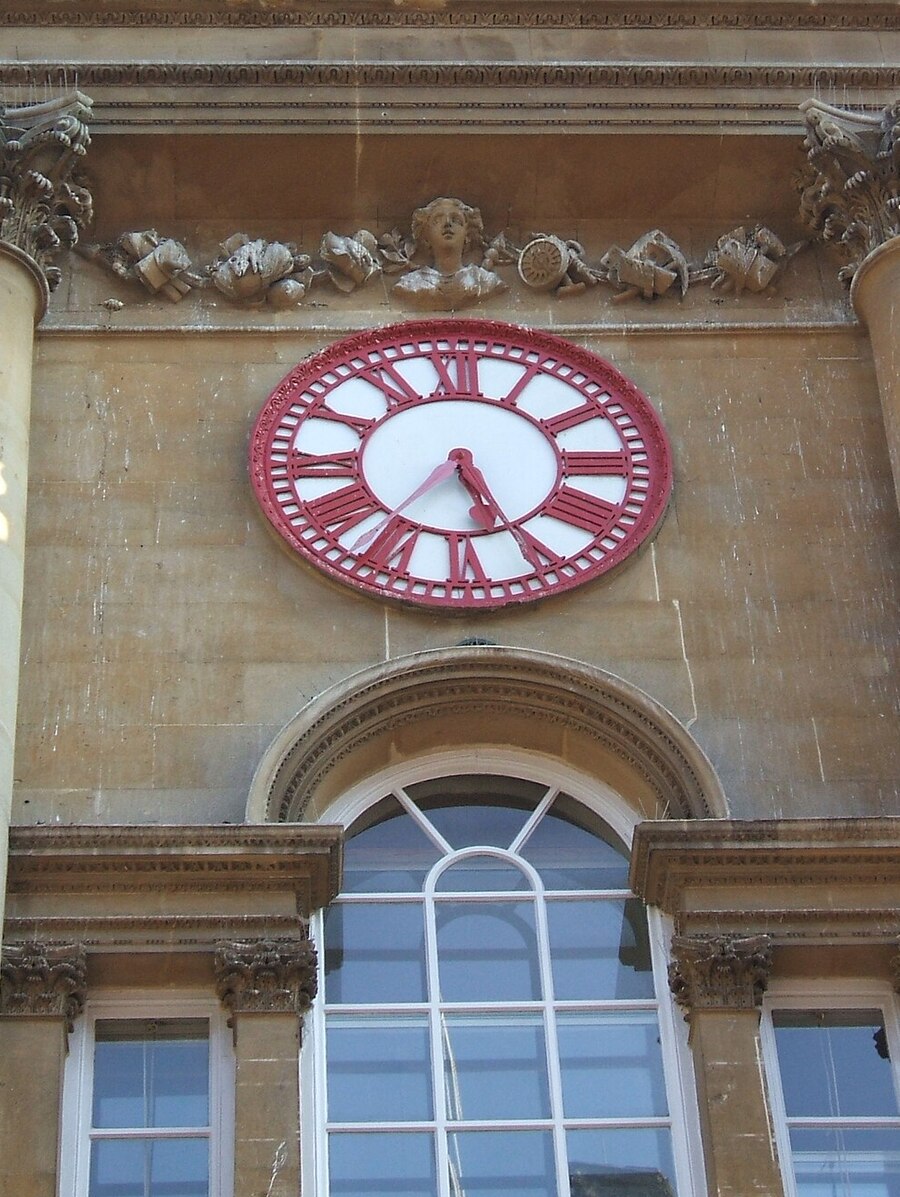

Both hands are still on that clock. You can go and look at the disagreement.
Across the Atlantic the switch came at noon on 18 November 1883, when American and Canadian railroads adopted standard zones — four across the United States, five counting the Intercolonial zone — and a great many cities experienced two noons in one day: the local one, and then the new one. Not everyone was charmed. The Indianapolis Sentinel complained that citizens would now have to “eat, sleep, work … and marry by railroad time” — the wording varies between surviving accounts, but the exasperation does not.
They were not being unreasonable. Something genuinely had been taken away: the direct relationship between the clock on your wall and the sun over your head. It was replaced by a relationship with a railway company’s schedule.
What the famous conference did not do
The 1884 International Meridian Conference in Washington is where popular accounts say the world’s time zones were created.
It isn’t. The conference adopted Greenwich as the Prime meridianThe zero-longitude line from which east and west are counted: Greenwich's from 1884; today a satellite-defined line about 102 metres east of it.Read more on Wikipedia ↗ and defined a “universal day”, and it explicitly declined to impose time zones. The Royal Observatory Greenwich is blunt about this: the conference did not adopt time zones, contrary to popular belief. The zone system arrived piecemeal afterwards, country by country, over decades.
Two smaller corrections worth having, since both are repeated confidently and both are wrong. France did not vote against Greenwich — France and Brazil abstained, and the single opposing vote came from San Domingo. And Sandford FlemingScottish-Canadian engineer (1827-1915) who campaigned for worldwide standard time zones and the Greenwich prime meridian.Read more on Wikipedia ↗ did not invent standard time: he was a formidable advocate, but Charles F. DowdAmerican educator (1825-1904) who first proposed multiple railway time zones for the United States.Read more on Wikipedia ↗ had proposed a national zone system in 1870 — reckoned then from the Washington meridian, and shifted to Greenwich two years later — and it was the railway manager William Frederick Allen who actually brokered and implemented the American scheme.
Some countries settled onto a standard offset only within living memory. Nepal moved to Coordinated Universal Time (UTC)The world's reference time scale, kept by atomic clocks and held within a second of Earth's rotation; time zones are stated as offsets from it.Read more on Wikipedia ↗+5:45 in 1986, a forty-five-minute offset rather than a neat hour — an approximation of Kathmandu’s own Mean solar timeClock time based on a smoothed average Sun rather than the real one, so every day is an even 24 hours.Read more on Wikipedia ↗, which runs 5 hours 41 minutes ahead of UTC. It is often called the last such adoption, though that superlative is harder to source than it looks.
What we actually agreed to
It is worth being precise about what happened, because it is easy to describe as clocks “becoming accurate”. They did not. The clock in Bristol was never wrong.
What changed is that we stopped defining time by a local observation and started defining it by a shared agreement. Noon stopped meaning the sun is overhead here and started meaning everyone in this region has consented to call this moment noon. That is a different kind of fact — and it is the same kind of fact that lets any two clocks agree today, from a train timetable to the hundredths that decide a race.
Your phone does this constantly and silently. It carries a time it did not measure, handed to it by a network, referred to a standard maintained by institutions you will never see, and it is right about the hour for exactly the reason the Great Western’s timetable was right: enough people agreed.
When you press start on TiCaNo Stopwatch, none of that matters, which is the interesting part. An elapsed time is the one measurement that needs no agreement at all — a difference between two moments on the same clock, meaningful even if that clock disagrees with every other clock in the world. Nobody has to consent to how long your run took.
Sources
- Standardising time: railways and the electric telegraph — Science Museum, quoting the June 1841 GWR timetable
- 180 years of railway time — Network Rail
- Railway time — Wikipedia, citing the Exeter Flying Post (4 Nov 1852) and Hamerla (2006)
- Valley Falls train collision — Wikipedia, citing Reed, Train Wrecks (1968) and the Boston Daily Evening Transcript, 18 Aug 1853
- America’s first time zone — Harvard Gazette, 2011
- The Exchange, Bristol — Wikipedia
- The adoption of a Prime Meridian and the International Meridian Conference of 1884 — Royal Observatory Greenwich
- Proceedings of the International Meridian Conference, 1884 — via Project Gutenberg
- The Day of Two Noons — Library of Congress
- The New Railroad Time — New York Times, 12 October 1883
- Nepal Standard Time — Wikipedia