



Pick any date and the world cannot agree what to call it. Most of the planet lives on the Gregorian calendarThe calendar of most of the world since 1582: 365 days with a leap day in most years divisible by 4, except century years not divisible by 400.Read more on Wikipedia ↗; churches still on the Julian calendarThe calendar Julius Caesar adopted in 46 BC — a leap day every four years, no exceptions — still kept by several Orthodox churches for fixed feasts.Read more on Wikipedia ↗ keep a different one, and their Christmas falls in January. Islamic countries tend to run the Gregorian for business and keep the Hijri calendar for religion; the Hijri year is 354 or 355 days long. China prints both. India runs dozens in parallel.
The usual explanation is history: different civilisations kept their own. True, and it explains nothing. The real answer is arithmetic, the same for every calendar there is.
Three clocks that do not mesh
A day is one turn of the Earth. A month is one turn of the Moon’s phases. A year is one turn of the seasons. Three clocks, three rates — and the rates do not divide into each other.
The mean Tropical yearThe cycle of the seasons — one full round of the seasons as marked by the equinox — about 365.2422 days; no calendar's year is exactly this.Read more on Wikipedia ↗, the cycle of the seasons, is 365.2422 days. The mean Synodic monthThe cycle of the Moon's phases, new moon to new moon, about 29.53059 days — the unit lunar calendars count years in.Read more on Wikipedia ↗, new moon to new moon, is 29.53059 days. Neither is a whole number, and — this is the crux — neither divides the other. Twelve lunar months come to about 354.37 days, some eleven days short of the solar year, and no multiple of months ever lands exactly on a multiple of years. Calendars are complicated precisely because the month and the year are neither whole numbers of days nor commensurable with each other.
So every calendar maker faced the same forced choice: which clock do you follow exactly, and which fraction do you quietly drop? Every traditional calendar is a different answer to that one question. The six answers below are all still in live use, and they cannot all be right at once — they describe the same sky.
The great near-miss
Before touring the answers, meet the arithmetic that keeps coming back. Nineteen solar years and 235 lunar months are almost the same length: both about 6,939 days, differing by roughly two hours. Follow the moon for 235 months and you have also followed the sun for 19 years, near enough to keep both happy for a lifetime.
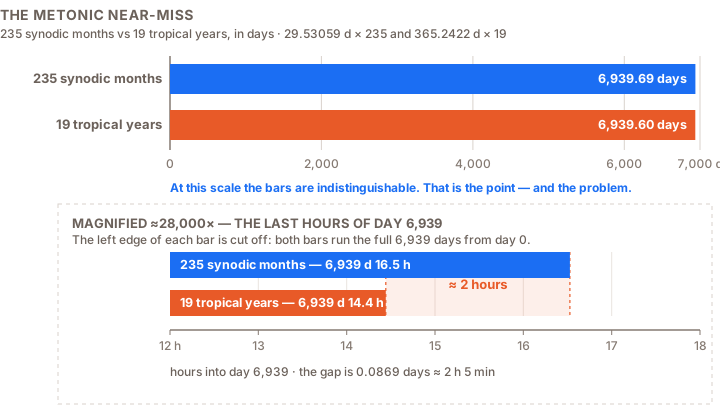
This is the Metonic cycle, named after Meton of Athens. The naming is the Greek tradition; the relation itself was worked out in Babylon around the fifth century BC. Babylonian calculators ran an almost perfect 19-year, 235-month scheme under the Persian kings. Keep the 19-year coincidence in mind: it powers the Hebrew calendar and the arithmetic Christians used for centuries to date Easter.
Bet one: keep the year, drop the moon
Rome before Caesar had a calendar mess, and the mess was political. The pontiffs added months at pleasure, and the calendar drifted so far that — in the Roman biographer Suetonius’ complaint — the harvest festivals no longer came in summer nor the vintage festivals in autumn.
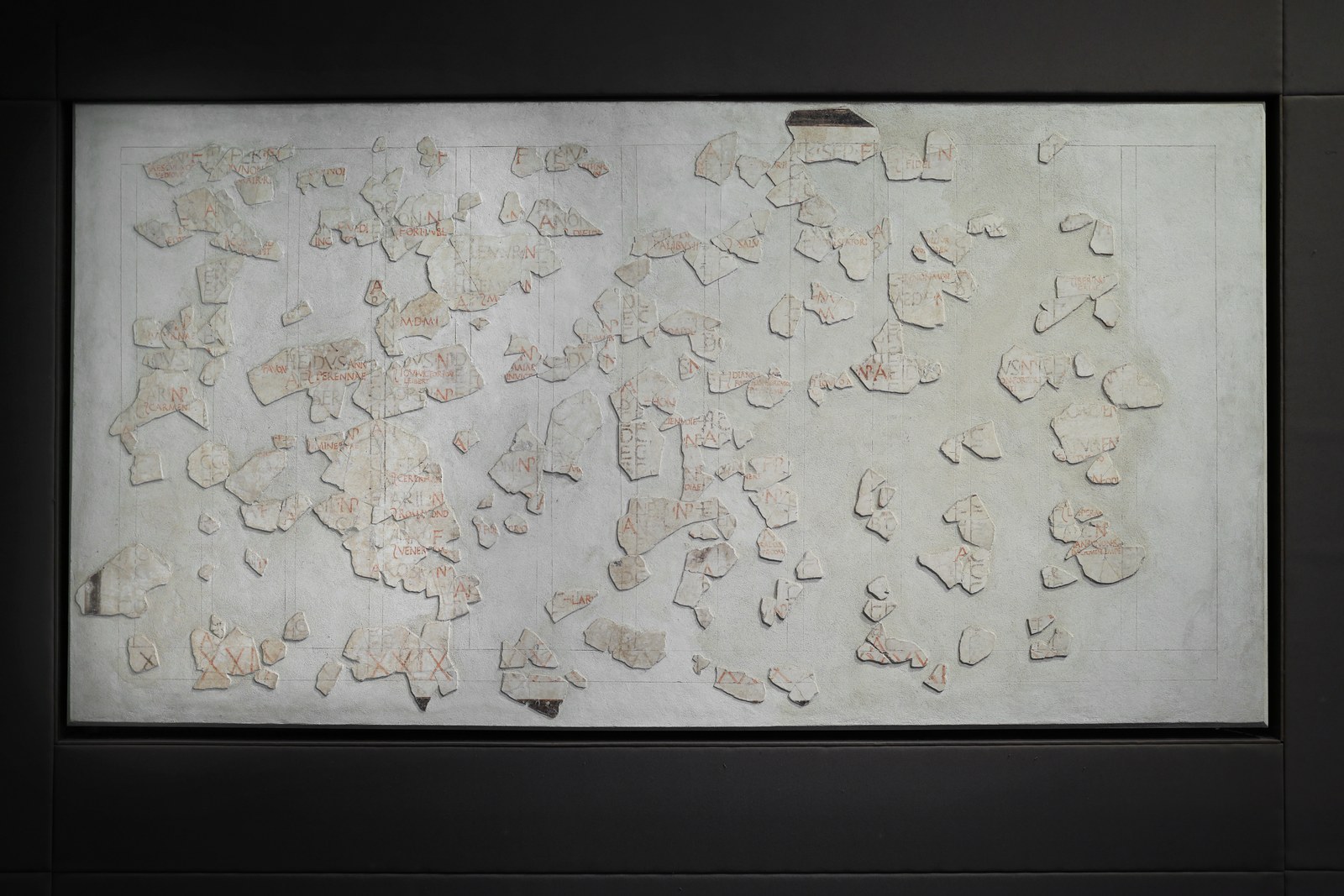
In 46 BC, on the advice of the Alexandrian astronomer Sosigenes, Julius CaesarRoman general and statesman (100–44 BC) whose calendar reform of 46 BC created the Julian calendar.Read more on Wikipedia ↗ swept the priesthood aside and made the year purely solar — 365 days, a leap day every fourth year. Mean year: exactly 365.25 days. The moon was released from duty and went back to governing tides and night lighting.
The bet was clean, and wrong by a little: 365.25 is about 11 minutes longer than the actual year. Eleven minutes is nothing — until nobody fixes it for sixteen centuries. The error is about one day every 130 years, and by the 1500s the spring equinox had slipped from March 21 to March 11.
Bet two: keep the year, sharpen it
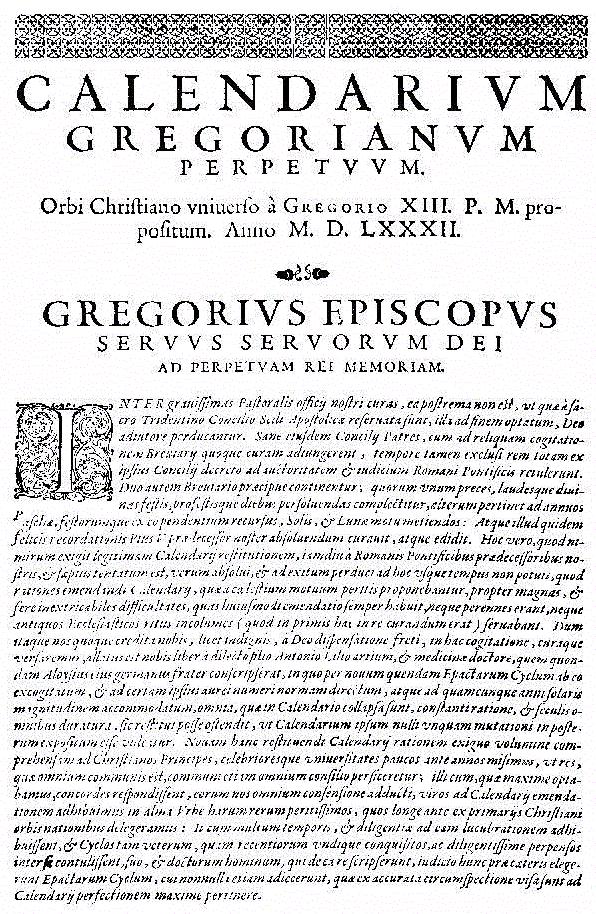
The correction came from the pope, and the reason was not farming. The stated purpose of Gregory XIII’s reform was Easter, spelled out in the bull Inter gravissimas of 24 February 1582. Put the equinox back where the Council of Nicaea had fixed it. Correct the church’s lunar tables. Keep the celebration on the right Sunday.
The surgery was blunt. Ten days were removed from October 1582: Thursday the 4th was followed by Friday the 15th, and the equinox of 1583 fell back near March 21. The long-term fix was a refinement of the leap rule: century years would count as Leap yearA year with an extra day inserted, keeping a calendar aligned with the seasons when its ordinary year runs short.Read more on Wikipedia ↗s only when divisible by 400. The years 1700, 1800 and 1900 were skipped; 2000 was not. Mean year: 365.2425 days — about eleven seconds a year off the vernal-equinox year, and roughly twice that against the mean tropical year quoted earlier. How far even this drifts depends on which definition of “the year” you compare against: respectable references give anywhere from about three to about eight thousand years per day of drift. Slow, certainly; by how much, not settled.
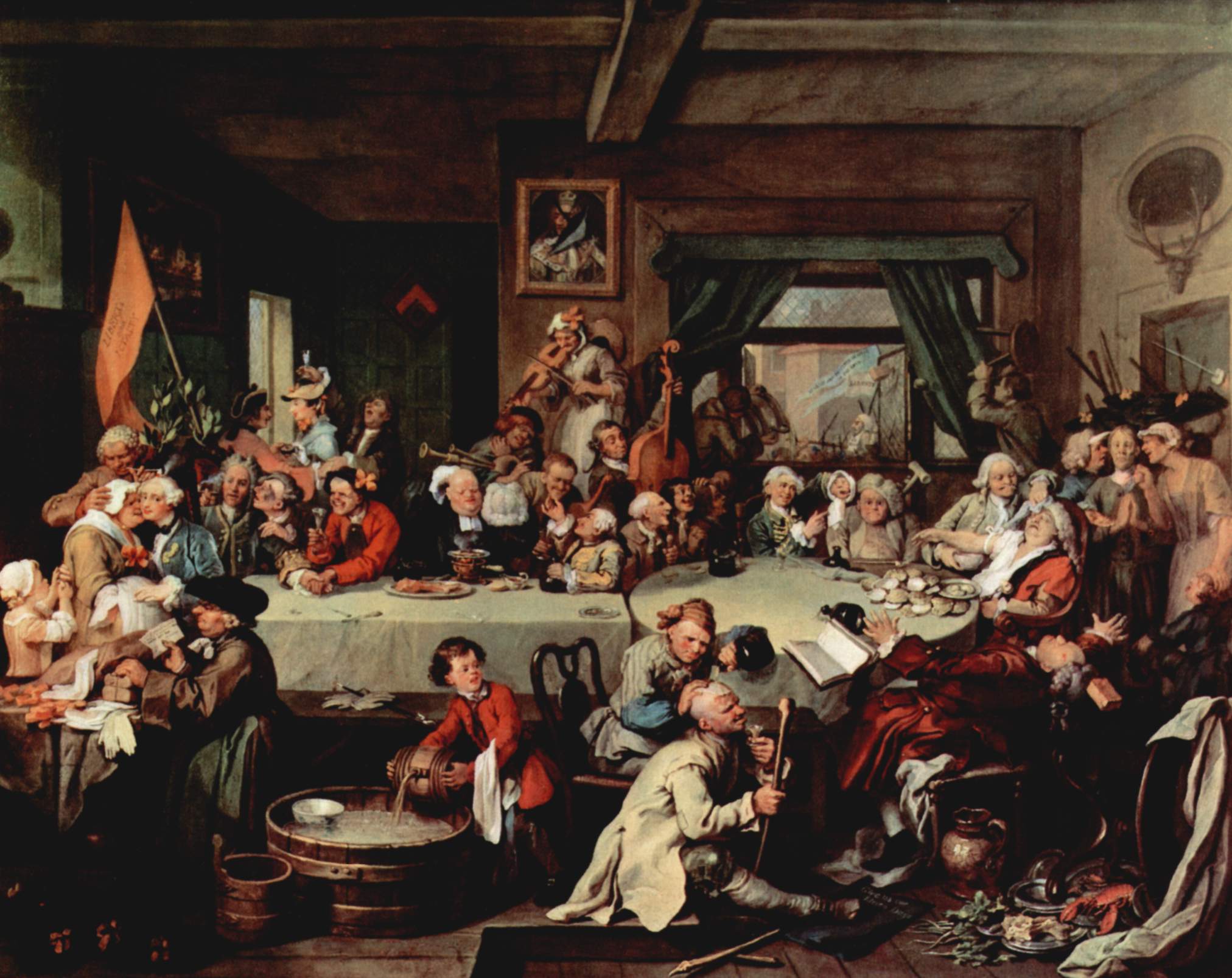
Adoption is its own comedy. Catholic Europe switched in 1582; Protestant Europe took the position that a pope could not move their calendar, then switched anyway — Britain and its American colonies not until 1752, by Act of Parliament, dropping eleven days from September. The famous story of mobs rioting to demand their eleven days back is a myth — a banner in a painting by William HogarthEnglish painter and printmaker (1697–1764), the leading satirist of his age.Read more on Wikipedia ↗, debunked by historians. Orthodox Russia held out until 1918 — citizens went to bed on 1 February and woke on the 14th — and Greece until 1923, by then thirteen days behind.
And the Julian calendar never died. Several Orthodox churches still keep it for fixed feasts, which is why their Christmas falls on January 7 in civil terms. Not all of them: Greece, Cyprus and Romania moved their liturgical calendar and celebrate on December 25.
Bet three: keep the moon, drop the sun
The Islamic calendar makes the opposite bet, and makes it on purpose. The Qur’an fixes the number of months at twelve and condemns the old pre-Islamic practice of shuffling them to chase the seasons. No leap months, no leap days: twelve lunations, 354 or 355 days, forever.
The consequence is famous: the months walk backwards through the seasons, returning to the same point roughly every 33 years. Ramadan falls in summer some years, winter in others. From outside this looks like a defect; from inside it is the design. The moon is the contract, and the seasons were never part of it.
The bet has one operational seam. A month begins, in principle, with the first visible crescent — and the moment a young moon first becomes visible cannot be computed exactly. So practice splits: some authorities rely on actual sightings, others on calculation, and countries disagree. Saudi Arabia’s civil Umm al-Qura calendar is computed from the conjunction and moonset at Mecca. Under its own rules the crescent is usually still invisible on the first evening of the month anyway. Religious authorities can adjust the date after reported sightings. Same moon, different dates.
Bet four: follow both
The Hebrew and Chinese calendars refuse to choose, and each pays for it in complexity.
The Hebrew requirement is religious: the Torah fixes the month by the moon and Passover to the spring, so the calendar must track both. The solution is the Metonic cycle in pure arithmetic — seven leap months per nineteen years, months starting at the calculated conjunction, plus postponement rules. It is entirely calculated; nobody is watching the sky. Its origin story is shakier than tradition says. The fixed calendar is credited to the patriarch Hillel II in the fourth century, but that attribution survives through a single 11th-century report. The details have been lost, and scholars think the final form settled centuries later. Even the finished article drifts: the assumed year runs about six and a half minutes long, pushing the calendar against the equinox by about a day every two hundred years.
The Chinese calendar is also computed, but it chooses its leap month by event rather than cycle. Months run new moon to new moon; when a solar year contains thirteen of them, the first month with no major solar term becomes the leap month. The rule produces about seven leap months per nineteen years — as an outcome, not a law. The instants are computed for the 120° East meridian, and published tables of the result often disagree with each other. New Year lands between January 21 and February 20; the popular rule of thumb — second new moon after the winter solstice — usually works, and in 2033 it will fail for the first time since 1645.
Bet five and six: the sun alone, and all of the above
Iran’s Solar Hijri calendar, official since 1925, takes the remaining clean option: ignore the moon; the year is the Sun’s actual passage through the vernal equinox. Nowruz — new year — is the equinox itself, observed to the moment, leap years following where astronomy leads. Afghanistan adopted a twin in 1957.
And then there is India, which is not one calendar but a family. A government reform committee in 1955 counted about thirty calendars in religious use in India. The national civil calendar runs alongside them, the Gregorian runs alongside that, and different regions even start and end the same lunar month on different days.
Why they all survive
Side by side, the disagreements are permanent. The calendars anchor their years to different points. The Gregorian follows the equinox, the Chinese the winter solstice, the Persian the equinox again — observed rather than averaged. And observational calendars must also choose a meridian to observe from. They even disagree on when a day begins: midnight in the Gregorian world, sunset in the Islamic and Jewish ones, dawn in some Indian systems. One moment in time maps onto several different dates at once.
The real reason so many survive: they do different jobs. Civil life almost everywhere rides the Gregorian calendar, because commerce wants one shared grid. Religious life keeps its own, because the rituals were promised to the moon or the equinox, not to a shared grid. Islamic countries, India and China all run exactly this dual system today — one calendar for the office, another for the festival.
None of them is wrong. The day, the month and the year are three real cycles that do not fit together, and a calendar is just a decision about which mismatch to live with. The Gregorian decided the moon was somebody else’s problem. The Hijri calendar decided the same about the sun. The Hebrew and Chinese calendars took on both and pay for it in leap months. The Persian calendar shrugged and pointed at the equinox.
Down at the bottom, below every argument, days, hours and seconds divide cleanly — the part of timekeeping nobody fights over. To measure one of those clean units, the instrument is a stopwatch, and it ignores the calendar you file the result under. One layer down, the same incommensurability between the day and the second gives us the leap second — its own story.
Sources
- E.G. Richards, “Calendars,” ch. 15 of the Explanatory Supplement to the Astronomical Almanac (3rd ed., 2012), USNO-hosted — incommensurability, year and month lengths, Julian drift, the Gregorian reform, Hebrew and Chinese rules, day-start conventions, dual-calendar usage.
- Inter gravissimas, Gregory XIII, 24 February 1582 (Wikisource English translation) — ten days removed, the centurial leap rule in the bull’s own words, Easter as stated purpose.
- Encyclopaedia Britannica — Gregorian-calendar article (drift figures, adoption timeline), Islamic calendar (354/355-day years, ~32.5-year seasonal cycle), Jewish religious year (structure, Hillel II attribution, origin), Hindu calendar (secular/religious split, amanta and purnimanta), Metonic cycle. Article bodies only; Britannica’s embedded AI-generated Q&A blocks are not cited.
- US Naval Observatory, “Introduction to Calendars” — Metonic cycle (“off by about 2 hours”), Julian and Gregorian leap rules, crescent visibility.
- Suetonius, Divus Julius 40 (Loeb translation) — the pontiffs’ disordered calendar and Caesar’s reform.
- Calendar (New Style) Act 1750 (24 Geo. 2 c. 23), excerpted by WebExhibits — New Year’s Day moved, eleven days omitted in 1752. WebExhibits also carries the popular “1 day in 128 years” Julian-drift figure; the reference works say about 130.
- Qur’an 9:36–37 (Quranic Arabic Corpus, Sahih International) — twelve months, the condemnation of postponement.
- R.H. van Gent, Utrecht University, on the Umm al-Qura calendar’s astronomical rules — conjunction and moonset conditions, crescent usually invisible on day one, religious-authority adjustment.
- Helmer Aslaksen, “The Mathematics of the Chinese Calendar” (NUS) — zhongqi leap-month rule, the New Year date range, the second-new-moon rule of thumb and its 2033 failure.
- M. Heydari-Malayeri, “A Concise Review of the Iranian Calendar” (Paris Observatory, arXiv) — the equinox-defined year. His assessment of Persian-calendar superiority is the author’s own and is not repeated here.
- Jewish Encyclopedia (1906) — the Hebrew calendar’s 19-year excess and ~216-year equinox drift, per Isidore Loeb.
- Lewis Siegelbaum, Seventeen Moments in Soviet History (MSU) — the February 1918 switch, 13 days. TIME (Jan 2023) — Orthodox Christmas dates and the revised-Julian churches.
- Historic UK on the calendar riots — the myth’s Hogarth origin.