



Open any server log and every timestamp ends with the same letter: Z. Ask a room of engineers what that letter means and you will hear “zero offset”, “Greenwich”, “London time in winter”. All three answers are close enough to be dangerous. Coordinated Universal Time (UTC)The world's reference time scale, kept by atomic clocks and held within a second of Earth's rotation; time zones are stated as offsets from it.Read more on Wikipedia ↗ (UTC) is not a Time zoneA region that keeps one standard time by law or agreement, usually stated as an offset from Coordinated Universal Time (UTC).Read more on Wikipedia ↗, not a place’s time, and not GMT (Greenwich Mean Time (GMT)Mean solar time at the Royal Observatory, Greenwich; once the world's reference for civil time, now largely replaced by Coordinated Universal Time (UTC).Read more on Wikipedia ↗) — it is a time scale, an agreed way of counting seconds that the world’s clocks are steered toward. The distinction sounds pedantic. It is the reason a server and a watch can both be working perfectly and still disagree.
An agreement, not a place
A time zone is a civil rule about which clock a place keeps — we have covered how political that gets. UTC is the other thing: the international reference scale that all those zones express themselves against. The rulebook that defines it — the International Telecommunication Union’s (ITU) time signals and frequency standards emissions series (TF) Recommendation TF.460-6 — is admirably direct. UTC is the time scale maintained by the International Bureau of Weights and Measures (BIPM), with help from the International Earth Rotation and Reference Systems Service (IERS), the service that tracks Earth’s rotation. It runs at exactly the rate of atomic time, differs from it by a whole number of seconds, and is kept close to the rotating Earth by the occasional insertion of a Leap secondAn occasional one-second adjustment to Coordinated Universal Time (UTC) that keeps it within 0.9 seconds of time based on Earth's rotation.Read more on Wikipedia ↗.
That last clause is the whole design. The raw material underneath is International Atomic Time (TAI)The continuous time scale computed from hundreds of atomic clocks worldwide; Coordinated Universal Time (UTC) is built on it, offset by leap seconds.Read more on Wikipedia ↗ (TAI), which the US National Institute of Standards and Technology (NIST) describes as a weighted average of more than 300 atomic clocks at more than 60 timing laboratories. Atomic clocks are superb at ticking steadily and useless at knowing which way the planet is facing. Earth rotation — the universal time (UT) family — knows where the planet is but drifts irregularly. UTC is the marriage: atomic rate, corrected by whole seconds so it never strays more than 0.9 seconds from Universal TimeThe family of time scales based on Earth's rotation — essentially, time kept by the sky. It runs unevenly, because the planet does not spin at a constant rate.Read more on Wikipedia ↗, the rotation reading. Neither partner is demoted; the scale is named for the coordination itself.
The world’s civil clocks hang off this arrangement. A 1975 resolution of the 15th General Conference on Weights and Measures (CGPM) noted that UTC “provides the basis of civil time, the use of which is legal in most countries”, and endorsed it. Note the direction of that sentence. Countries did not adopt UTC as a zone. Their zones are stated as offsets from it — UTC−5, UTC+3 — and the offsets are the part politicians keep rewriting.
What the C stands for
Coordinated. Of course. But you may have heard the joke: that the C “really” stands for Compromise, because the English wanted CUT (Coordinated Universal Time) and the French wanted TUC (temps universel coordonné). It is a good joke and it is folklore — no standards document says it. What is documented is better.
In 1970, an advisory group of technical experts within the ITU, the international telecommunication union, wanted a single abbreviation that would work in every language. In English, Coordinated Universal Time abbreviates to CUT. In French, temps universel coordonné gives TUC. NIST’s account of the group’s reasoning: to avoid appearing to favor any particular language, the abbreviation UTC was selected — matching neither side.
The archival record adds a twist the joke misses. The ordering UTC appeared in print as early as 1965, in the Bulletin Horaire of the Bureau International de l’Heure, the body then running international time coordination — five years before that ITU group met. Steve Allen, whose documentary history of the timescales is the standard reference on the era, notes the earliest known use and observes that the ordering fits the astronomical naming scheme of the day, UT0, UT1, UT2. UTC slides into that sequence as if it had always been there.
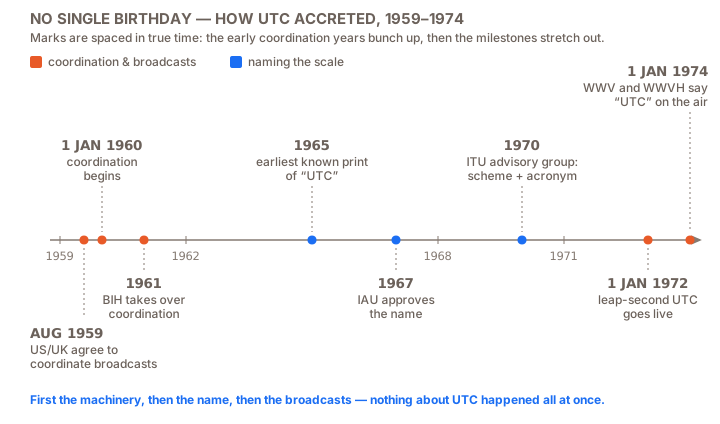
The messy part is the timeline, and it resists any single birthday. The US and UK radio stations agreed to coordinate their time transmissions in August 1959 and started on the first of January 1960; the Bureau International de l’Heure took over coordination in 1961. The name Coordinated Universal Time was approved by the International Astronomical Union in 1967. The leap-second mechanism was decreed in 1970 and went live in 1972. The single acronym was settled by an ITU advisory group in 1970. Anyone who tells you UTC was invented in one year is compressing five events into one.
Why it is not GMT
GMT has split into two meanings, and keeping them apart is most of the work. Originally it meant mean solar time at the Royal Observatory, Greenwich — an astronomical scale that followed the irregular motion of the Earth. The modern term for that scale is UT1, the same rotation reading UTC is steered toward. But in everyday use, NIST notes, GMT now more commonly names the time zone at the prime meridian: a local representation of UTC, not of UT1.
So “GMT” today usually means “civil time at offset zero”, which is a zone wearing an old name. The scale it used to name lives on as UT1. And the two are not identical: UTC is held within 0.9 seconds of UT1 by design, so equating GMT-as-zone with the old GMT-as-scale is fine only when fractions of a second do not matter.
The handover had a visible moment. On the first of January 1974, the US radio stations WWV (run by the National Bureau of Standards) and WWVH (its sister station) stopped announcing the time as GMT and began announcing it as UTC. A few broadcasters kept saying “GMT” for a few years after 1972 while actually broadcasting the leap-second version of coordinated time — the transition was made of exactly this kind of confusion.
GMT is not even retired. British law still runs on it: under the Summer Time Act 1972, civil time in Great Britain during the summer period is “one hour in advance of Greenwich mean time”. The statute moves the civil clock; the thing it moves it relative to stands still.
Why the server and the watch disagree
Now the practical part. Your server reports times ending in Z, your watch shows a local hour, and occasionally they tell different stories. Three separate mechanisms, all sourced, none of them a bug.
The server’s UTC is a simplification. POSIX (the Portable Operating System Interface, the standard behind Unix time) defines every day as exactly 86,400 seconds and relates the count to a Coordinated Universal Time name. It is a day-count, not a count of real elapsed SI (International System of Units) seconds; leap seconds simply do not appear in it. The Z suffix itself is a timezone marker from Request for Comments (RFC) 3339, the internet timestamp standard: it denotes a UTC offset of 00:00, spoken “Zulu” from the International Civil Aviation Organization (ICAO) phonetic alphabet. NIST traces the Z zone to the alphabetic zone labels that maritime time used from the 1920s. The RFC’s own rationale for building timestamps on UTC is blunt: daylight-saving rules are so convoluted and can change by local law at unpredictable times.
Local time is political, and the corrections ship late. The Internet Assigned Numbers Authority (IANA) time zone database — tzdb, the data your phone and server both consume — describes itself as code and data representing the history of local time, updated when political bodies change boundaries, offsets or daylight-saving time (DST) rules. The updates reach end users through operating-system and software vendors, which is to say: eventually. The record is lively. Turkey switched to permanent UTC+3 in September 2016 with, in the database comment’s words, “not much notice”. Release 2026c carries the Canadian province of Alberta, which moved to permanent UTC−6 on 18 June, and Morocco, which moves to permanent UTC+0 on 20 September. A watch carrying last year’s rule table and an updated server are both computing correctly — from different law.
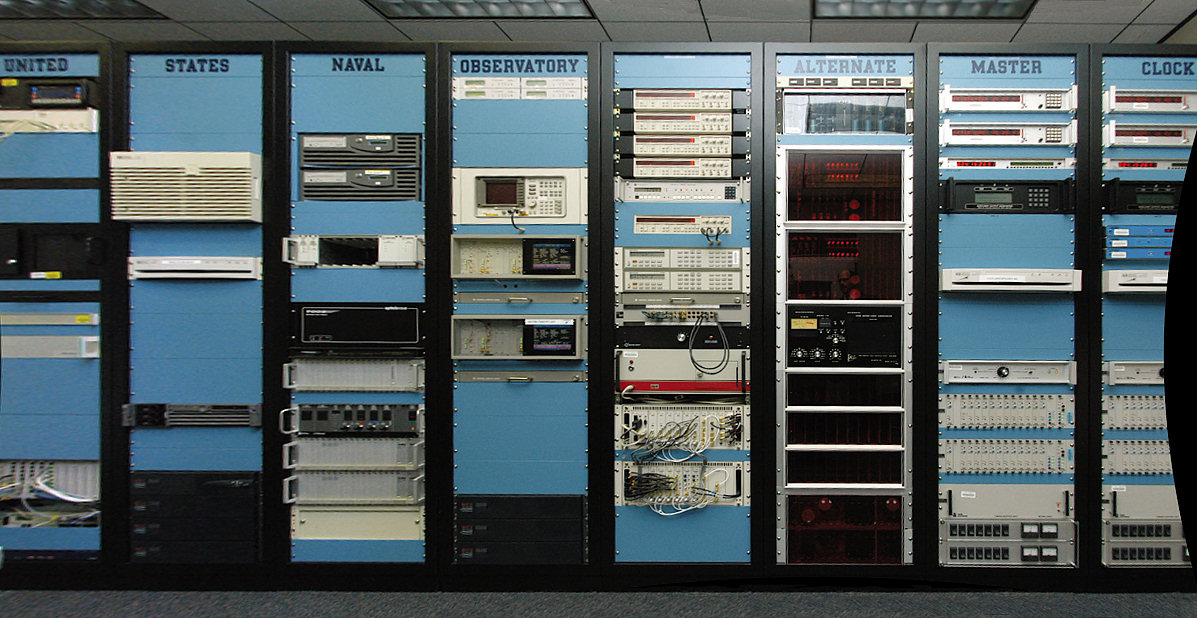
Nobody has real UTC anyway. TAI and UTC are “paper” time scales, computed by the BIPM after contributor data arrives; no clock keeps the official version in real time. Laboratories maintain their own realizations — UTC(k), within nanoseconds — with the differences published monthly in Circular T. The Global Positioning System (GPS) sidesteps leap seconds entirely: GPS time runs ahead of UTC as realized at the US Naval Observatory (USNO) by the integer count of leap seconds since January 1980 — eighteen seconds, as of the last one at the end of 2016 — and receivers apply the correction from the broadcast message. Even software’s one apparent exception, the tz database’s Etc/UTC zone, is an implementation artifact for functions like gmtime, not a jurisdiction. And on the International Space Station the schedule runs on UTC because, as the European Space Agency (ESA) puts it in its own astronaut FAQ (frequently asked questions), it sits around the midpoint between the mission controls in Moscow and Houston — though the same FAQ loosely calls it “the time zone for the Station”, which is exactly the confusion this post exists to unmake.
One thing UTC never does is change for summer. Zones shift around it — eastern standard time is UTC−5, eastern daylight time UTC−4 — but the scale itself is not adjusted during daylight saving.
The leap second, the mechanism holding all this together, has an end date on the books: the CGPM decided in 2022 that the allowed difference between UT1 and UTC will be increased in, or before, 2035. What replaces it is unsettled. The clock under the world’s clocks will keep ticking either way — a scale zones hang from, not a zone itself.
Which is the quiet point of that terminal Z. It marks a timestamp as belonging to no country, no season, no election cycle. A lap timer makes the same escape the other way: a duration needs no meridian, no offset and no letter at the end — which is why the splits in TiCaNo are readable on any continent without translation. If you want the full story of what a time zone actually is, that is its own post; the leap second’s mechanics are here.
Sources
- NIST, “How is UTC(NIST) related to UTC, TAI, GMT, USNO, GPS time and Zulu time?” — the FAQ behind the acronym story, the GMT two-meanings account, TAI’s construction, paper scales, GPS time and the Z zone.
- Recommendation ITU-R TF.460-6, “Standard-frequency and time-signal emissions” — the operative definition of UTC, the ±0.9 s tolerance and leap-second scheduling.
- BIPM, “Time metrology” and Circular T 463 — UTC’s maintenance, UTC(k) realizations, TAI−UTC = 37 s since 2017.
- Resolutions 5 (1975) and 4 (2022) of the 15th and 27th CGPM — civil-time basis and the 2035 decision.
- Steve Allen, “The wasted timescales of the modern era” (UC Observatories) — documentary history: Guinot’s 1965 Bulletin Horaire line, the UT0/UT1/UT2 ordering, WWV’s 1974 announcement switch.
- Nelson, McCarthy, Malys, Levine, Guinot, Fliegel, Beard & Bartholomew, “The leap second: its history and possible future”, Metrologia 38 (2001) — the 1959/1960 coordination origins and the 1967 International Astronomical Union (IAU) name approval. Its leap-second count (twenty-two) is correct as of its writing, not today.
- IERS Bulletin C 72 (July 2026) and Leap_Second.dat — 27 leap seconds since 1972, all positive; no leap second at end-2026; UTC−TAI = −37 s; last event 2016-12-31.
- RFC 3339 (IETF) — the Z suffix, its spoken name, and the DST rationale for UTC-based timestamps.
- Open Group Base Specifications Issue 7, §4.16 — POSIX’s exactly-86,400-second day and its UTC name.
- IANA Time Zone Database (release 2026c, and the europe/etcetera source files) — tzdb’s self-description, the Turkey comment, Alberta and Morocco 2026 changes, Etc/UTC.
- Summer Time Act 1972 s.1 (legislation.gov.uk) — British summer time as one hour in advance of GMT.
- ESA, Alexander Gerst astronaut FAQ (interested party on its own practice) — the International Space Station (ISS) schedule on UTC, Moscow–Houston midpoint; its “time zone” phrasing quoted as usage, not fact.