





















At the 1960 Rome Olympics, six officials stood over the finish of the men’s 100 metre freestyle with stopwatches in their hands. Three were watching the Australian, John DevittAustralian swimmer (1937–2023), gold medallist in the 100-metre freestyle at the 1960 Rome Olympics after a disputed decision.Read more on Wikipedia ↗. Three were watching the American, Lance LarsonAmerican swimmer who took silver in the 1960 Olympic 100-metre freestyle after a disputed finish against John Devitt.Read more on Wikipedia ↗. Devitt’s three all pressed at 55.2. Larson’s three read 55.0, 55.1 and 55.1 — a faster swim, by every one of them.
Larson lost.


The finish judges split, the cards as submitted actually indicated a tie, and the chief judge — who had no vote to cast — cast one anyway, for Devitt. An American appeal came with footage that appeared to show Larson touching first. It was rejected. Both men went into the record books at 55.2, a time neither of them was reliably measured to have swum.
That race is why swimming has touchpads.
The instrument that wrote
The word gives away how strange the earliest of these devices were. Chronograph is Greek for time-writer — khronos and graphein — and it was literal. The first ones marked a dial with ink. You read the elapsed time afterwards, off the trace.
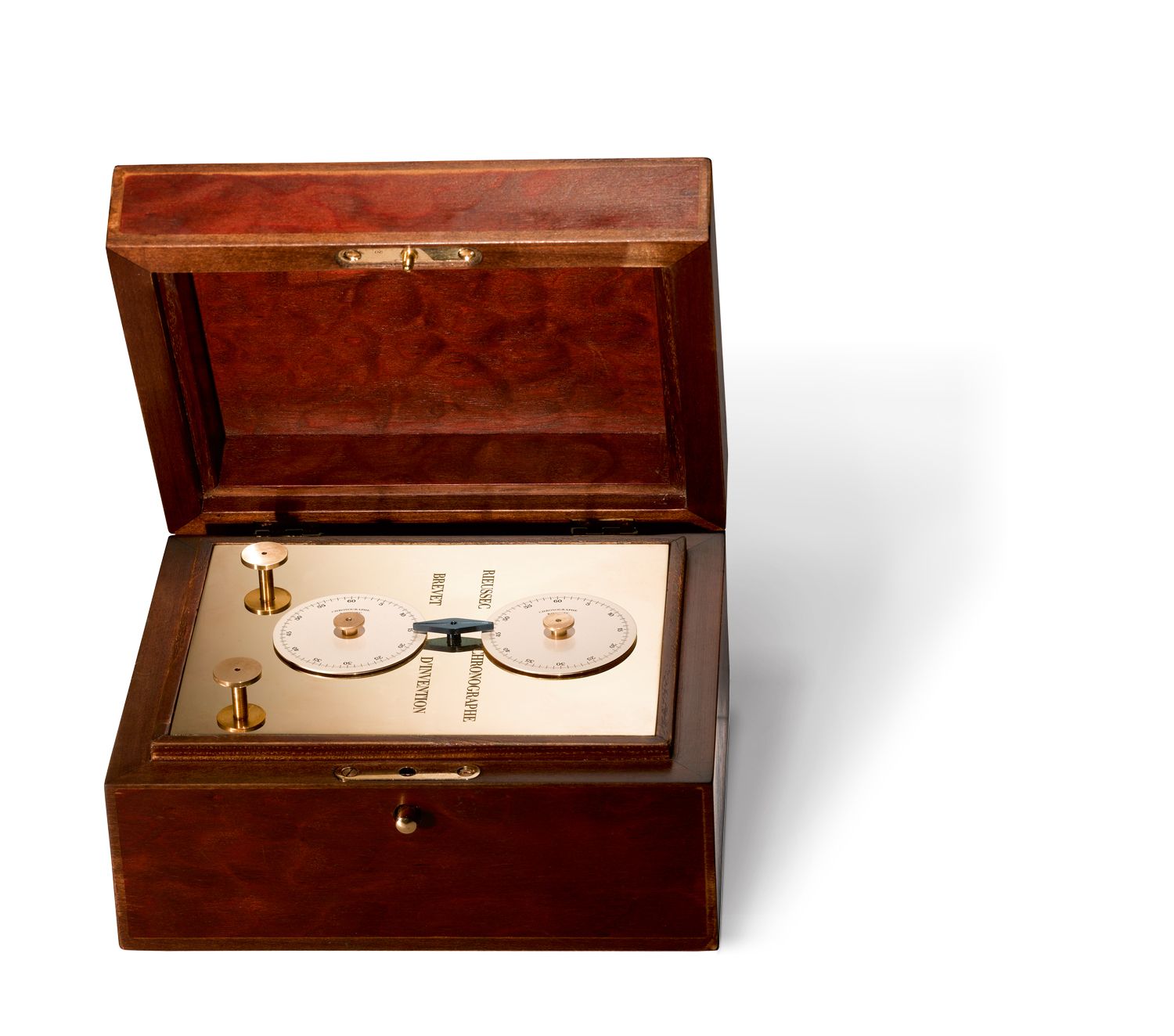

In September 1821, the watchmaker Nicolas Mathieu RieussecFrench watchmaker (1781–1866) credited with the first commercial chronograph, which marked elapsed time with ink, in 1821.Read more on Wikipedia ↗ set one up at a horse race on the Champ-de-Mars in Paris. It dropped a spot of ink onto a revolving dial each time he pressed. The patent he obtained the following March describes it almost exactly as an engineer would today — an instrument “indicating the duration of several successive phenomena without requiring the observer’s attention.” That last clause is the whole problem of timekeeping, stated in 1822.


Who actually invented the thing is genuinely disputed, and worth stating carefully. For most of two centuries the credit went to Rieussec. Then in 2013 a previously unknown instrument surfaced at auction: a high-frequency counter built by Louis MoinetFrench watchmaker and artist (1768–1853) whose 1816 timing counter is considered the earliest known chronograph.Read more on Wikipedia ↗, dated 1816, made for astronomy, and capable of resolving a sixtieth of a second. Whether that makes Moinet the inventor depends on whether you date the invention to the instrument or to the name. The Rieussec claim rests on a documented demonstration and a patent; the Moinet claim rests on a single surviving piece.
The improvement that mattered more than either was reset-to-zero, patented by Adolphe Nicole in 1844. Until then a timer could measure once. Afterwards it could measure again, and again — which is the entire difference between an instrument and a curiosity. Nicole’s patent took a long time to become an object you could buy: the pocket watch that combined all three functions, start, stop and reset, is usually dated to 1862.
There was one more mechanical trick, and anyone who has used a lap button already knows what it does. A rattrapante, or split-seconds chronograph, stacks two seconds hands on the same pivot. Stop one to read an intermediate time while the other keeps running, then release it and it springs forward to rejoin its twin. That is the lap-versus-split distinction, solved in brass, sometime in the 19th century.
The limit was never the watch
Here is the part that reframes the whole story: by the mid-20th century, the mechanism was no longer the weak link. The person holding it was.
Reaction timeThe delay between a signal and a person's response to it — about 180–200 milliseconds for a healthy adult reacting to something seen, faster for a sound.Read more on Wikipedia ↗ runs somewhere around 180 to 200 milliseconds, and it does not cancel out — it leans one way. A timer starts late on the gun and stops late on the finish, and the two errors do not sit symmetrically, so hand times come out consistently fast. Not by hundredths. A 1973 study at the University of Giessen measured the gap by where the timer stood: about 0.18 seconds for someone close to the start, 0.24 down at the end of the 100 metre straight, 0.26 around the 200 metre curve. Later laboratory work agrees and if anything runs higher: two studies of experienced timers put the gap at 0.31 and 0.22 seconds. This is not carelessness — it is physiology, and no amount of better watchmaking touches it.
Athletics eventually wrote the limitation into the rules. Hand times are trusted only to a tenth of a second, and are rounded up to the next tenth before anything else is done with them. When statisticians need to compare a hand-timed 100 metres against a modern one, they add 0.24 seconds — the Giessen figure for a timer at the finish. The Olympic record bears the correction out and shows officials slowly getting better at an impossible job: the average gap between hand and automatic timing in the men’s 100 metres ran about 0.24 seconds in 1952, 0.19 in 1956 and 0.15 in 1960.
Six people. One race. Four answers. Rome was not an aberration; it was the system working exactly as well as it could.
Handing the job to machines
The replacement had been arriving for decades. Photo finishJudging a close finish with a camera that records only a thin strip of the finish line many times a second, so each runner's crossing is captured exactly as it happens.Read more on Wikipedia ↗ images of races exist from around 1890. Stockholm used a camera on the 1500 metres in 1912, and it decided the medals. The first Olympic result timed automatically came in 1928, when a Löbner camera-timer caught the steeplechase winner at 9:21.60 against an official hand time of 9:21 and four fifths.
By 1932 the Los Angeles Games had a single official timekeeper for the first time — Omega, with thirty chronographs and one watchmaker to keep them honest — and still ran three timing systems side by side, because nobody yet trusted any one of them alone. The Bulova Phototimer, which timed the 1948 US Olympic trials, ran about two hundredths fast for a wonderful reason: it triggered on the sound of the starting gun. The sound had to travel. London’s Games that year used Omega’s photoelectric “Magic Eye” instead. In 1952 the Omega Time Recorder became the first Olympic timer to run on a quartz clock and print its own results.
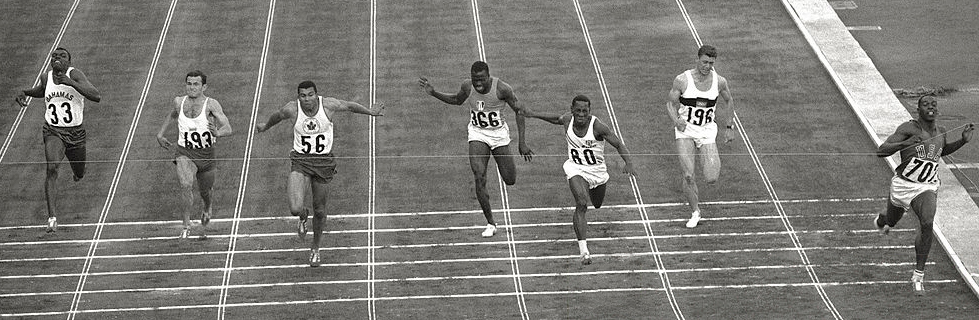

Then a strange interlude. At Tokyo in 1964, races were measured electronically and then published as though they had not been. Bob HayesAmerican sprinter, 1964 Olympic 100-metre champion, later an American-football receiver — the only man to win Olympic gold and a Super Bowl.Read more on Wikipedia ↗ was timed at 10.06; officials with stopwatches called 9.9; the result printed was 10.0 — the electronic figure with 0.05 subtracted and the remainder rounded to a tenth, an exact measurement dressed up in hand-timed clothing, because hundredths were not yet what the world expected to read. Four years later Jim HinesAmerican sprinter who, at Mexico City in 1968, recorded the first legally sub-10-second 100 metres under automatic timing (9.95 s); later an American-football player.Read more on Wikipedia ↗ ran the first sub-ten hundred under automatic timing at Mexico City. His hand time was 9.9; the electronic time entered the books as 9.95, and sources still disagree about how much correction sits inside that number. On 1 January 1977, fully automatic timing became mandatory for athletics world records up to 400 metres, and the argument was over.
The endpoint is Beijing, 2008. Michael PhelpsAmerican swimmer, the most decorated Olympian in history, with 28 Olympic medals.Read more on Wikipedia ↗ and Milorad ČavićSerbian swimmer, silver medallist in the 100-metre butterfly at the 2008 Beijing Olympics, 0.01 seconds behind Michael Phelps.Read more on Wikipedia ↗, 100 metre butterfly. Čavić appeared to win. The touchpads said Phelps, by one hundredth of a second — 50.58 to 50.59. Serbia protested. Officials reviewed the video and upheld the pads.
What the pads actually measured is still argued about. Omega’s timing chief, Christophe Berthaud, said in a 2009 interview that Čavić did reach the wall first and simply had not pressed hard enough to stop his clock, while Phelps, arriving a fraction later, hit the pad harder. FINA’s referee that day said the opposite — that Čavić plainly touched second. The official finish footage has never been released, and Čavić still says he won.
Which is the honest note to end the history on. A touchpad does not answer “who got there first.” It answers “who pressed this plate hard enough, soonest” — a slightly different question that everyone agreed in advance to treat as the same one. That substitution is what precision costs, and it is a far better deal than six people with six watches.
What you’re holding
Today’s Olympic finishes are judged by line-scan cameras taking 40,000 images a second of a single strip of ground. That is not what is in your pocket, and no phone app should pretend otherwise.
What is in your pocket is the end of a long argument about who gets to say when. The stopwatch stopped being a matter of opinion in stages — reset-to-zero, split-seconds, photo finish, quartz, touchpad — and every stage removed one more human judgement from the measurement.
TiCaNo Stopwatch is built on the same principle, in a small way. Laps are stored to microsecond resolution and the split is derived by addition rather than measured separately, so the two columns cannot disagree with each other. You still press the button yourself, and your thumb is still governed by the same two hundred milliseconds that beat Lance Larson. But everything after the press is arithmetic, and arithmetic does not have opinions.
Sources
- Swimming at the 1960 Summer Olympics – Men’s 100 metre freestyle — Wikipedia
- Controversy at the 1960 Olympic Games, Devitt vs Larson — International Swimming Hall of Fame
- 100 metres Freestyle, Men, 1960 — Olympedia
- Nicolas Mathieu Rieussec — Wikipedia, citing the 1822 patent (INPI 1BA5889)
- The chronograph: an expression of modern times — Europa Star
- A Little History of the Chronograph — Phillips
- Adolphe Nicole and the True Beginning of the Modern Chronograph — Philip Poniz, NAWCC Watch & Clock Bulletin, 2021
- Fully automatic time — Wikipedia
- Why 0.24 seconds is added to hand times — SpeedEndurance, on the 1973 University of Giessen study
- Hand time conversion standards — Athletic.net
- Photo finish — Wikipedia
- 1932 Summer Olympics — Wikipedia, citing the official report
- Swiss timekeepers at the Olympic Games — Swiss National Museum
- Athletics at the 1968 Summer Olympics – Men’s 100 metres — Wikipedia
- Milorad Čavić — Wikipedia
- The Milorad Cavic conspiracy — The Ringer, 2020
- How are photo finishes determined? — Olympics.com, quoting Omega’s Alain Zobrist on 40,000 frames per second
- Comparison between hand and electronic timing of 40-yd dash performance — Mayhew et al., J. Strength Cond. Res., 2010
- Validity and reliability of hand and electronic timing for 40-yd sprint — Mann et al., J. Strength Cond. Res., 2015
- 1948 US Olympic Trials report — Track & Field News
- Video, timing systems confirm Phelps’ 7th gold — NBC News / AP, quoting FINA referee Ben Ekumbo
- Michael Phelps vs Milorad Cavic, 100 butterfly, 2008 Beijing — SwimSwam
- The Milorad Cavic conspiracy — The Ringer, 2020