




















In Kashgar, in far western China, the sun can arrive at its highest point in the sky as late as ten past three in the afternoon.
That is not a fact about astronomy. It is a fact about which clock Kashgar is required to keep — a clock chosen in Beijing, for the whole country, and kept regardless of what the sun is doing over Xinjiang.
A time zone is not a stripe of LongitudeAngular distance east or west of the Greenwich zero line, measured in degrees up to 180.Read more on Wikipedia ↗. It is a decision about which clock a place agrees to keep. Governments make the decision, governments change it, and the map of those decisions is far stranger than the tidy picture you were shown at school.
The design sketch, and the machine underneath
The tidy picture is real, as far as it goes. Britannica defines a time zone as a band approximately 15° of longitude wide, running pole to pole, within which one uniform clock time is used. Twenty-four such bands would tile the planet at one hour per fifteen degrees.

That is the design sketch. The working machine is legal. No treaty fixes its lines; the railways argued the world’s clocks into agreement, and parliaments have been redrawing the result ever since.
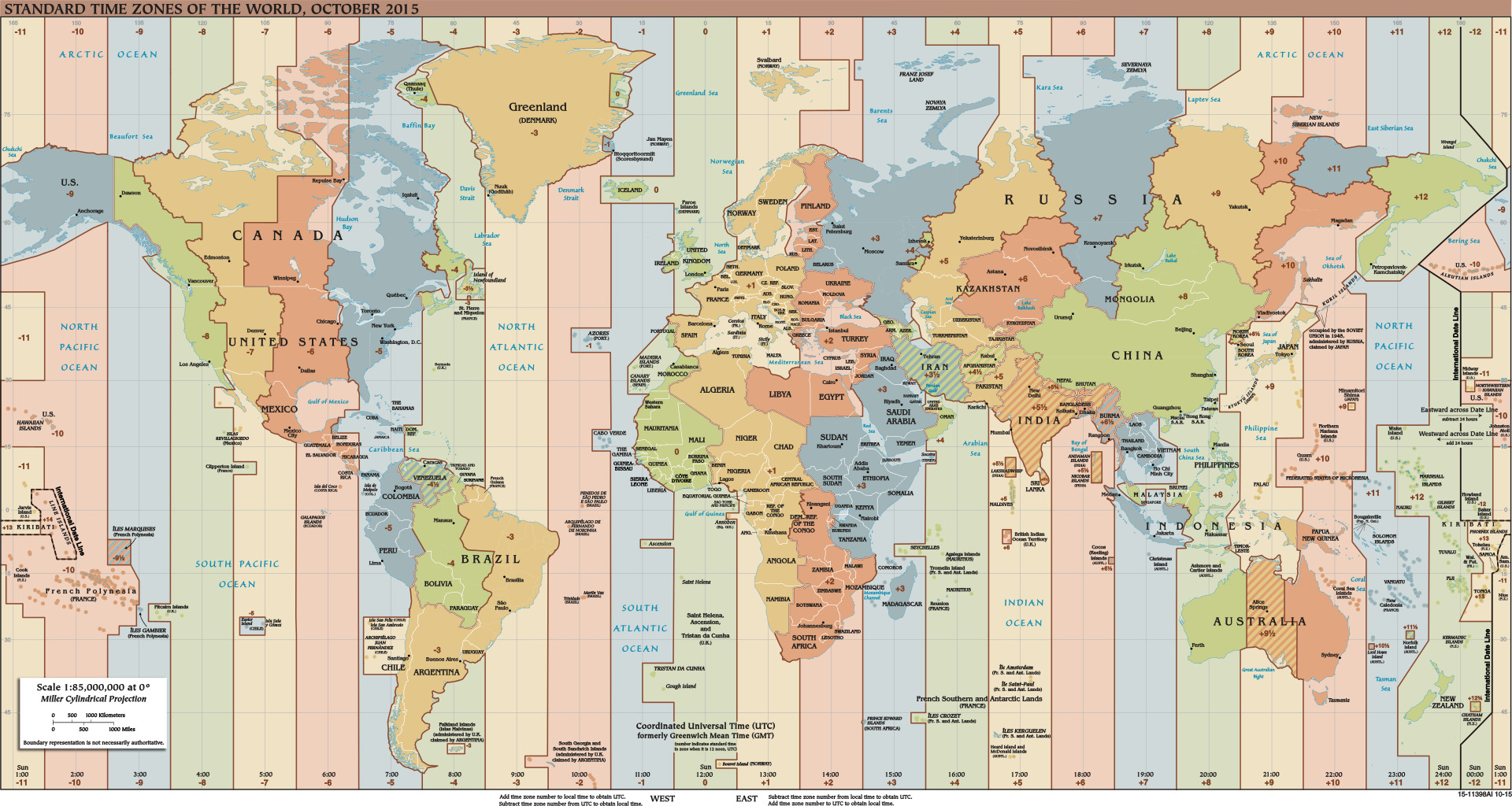
The proof is that offsets in real use are not all whole hours. India and Sri Lanka keep Coordinated Universal Time (UTC)The world's reference time scale, kept by atomic clocks and held within a second of Earth's rotation; time zones are stated as offsets from it.Read more on Wikipedia ↗+5:30. Nepal keeps UTC+5:45. Bhutan keeps UTC+6. There are more than two dozen distinct offsets in use worldwide, because each one is a choice somebody made for reasons that were usually political rather than arithmetical.
Why neighbours can differ by fifteen minutes
India spans almost thirty degrees of longitude — a width that in many parts of the world would naturally carry several time zones. It keeps one.
When India standardised, it chose the 82.5°E meridian, passing near the Allahabad Observatory, as its reference line. That works out to a tidy GMT+5:30 — half an hour off the grid of whole hours, permanently, because a line on a map was picked.
Not everyone accepted it calmly. When Indian Standard Time took effect on 1 January 1906, public clocks were vandalised, factories struck work, and nationalist patrons funded clock towers that intentionally displayed the “wrong” time.
Nepal, next door and sovereign, keeps its own answer: UTC+5:45, fifteen minutes apart from India.
The pattern runs both directions. A country the size of a continent can hold a single clock; a small one can cut a fifteen-minute slice. Sovereignty beats symmetry.
One country, five zones deleted
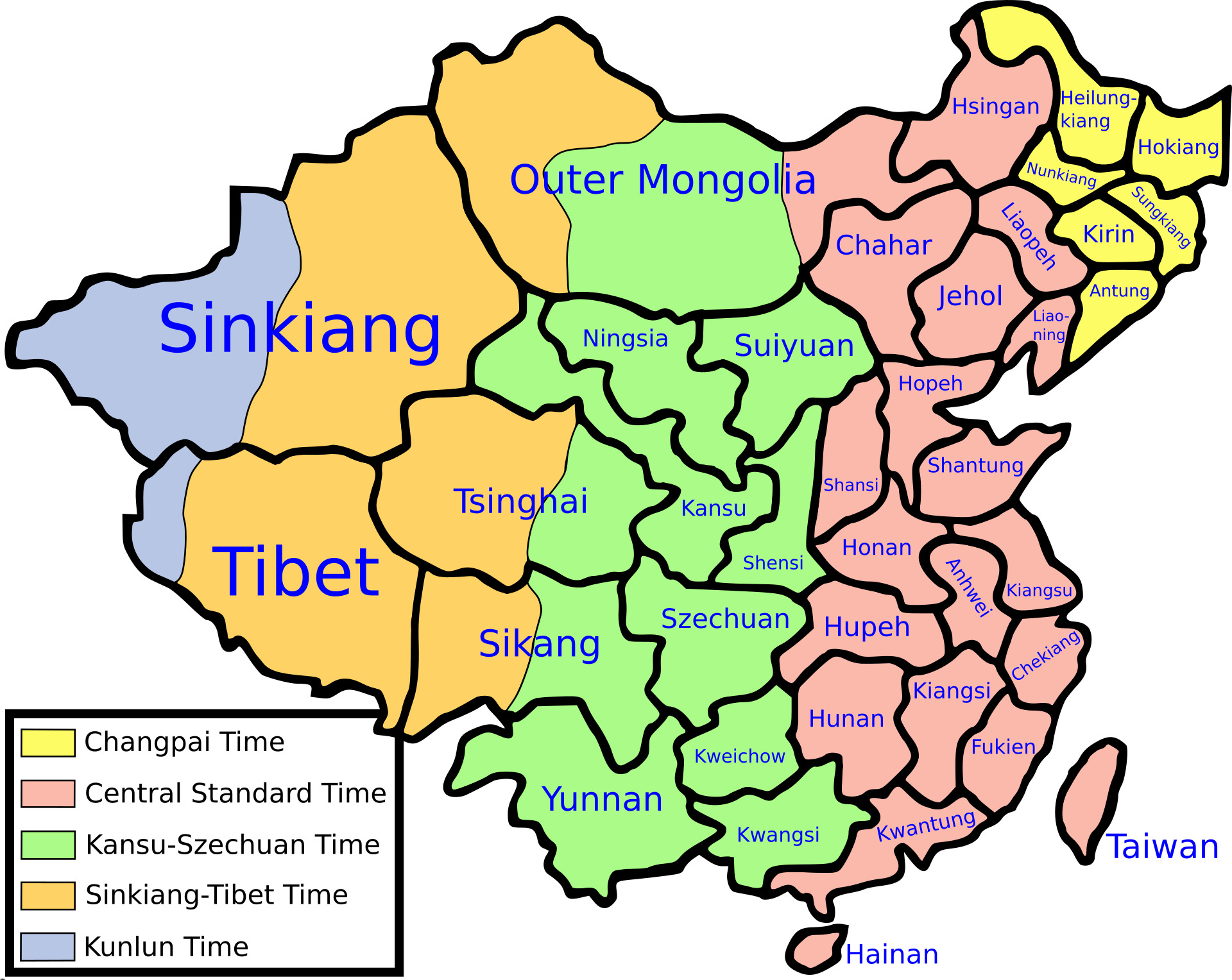
China ran five official time zones from 1912 to 1949 — from Kunlun Time at UTC+5:30 in the west to Changpai Time at UTC+8:30 in the east.
In 1949, Communist Party Chairman Mao ZedongFounder of the People's Republic of China, ruling it as Communist Party Chairman from 1949 to 1976.Read more on Wikipedia ↗ decided that all of China would use Beijing Time. Five zones became one, and the price is paid in daylight rather than distance. Hence Kashgar, where Solar noonThe moment the Sun crosses the local meridian, at or very near its highest point of the day. Clock noon can differ from it by many minutes.Read more on Wikipedia ↗ can land at 15:10: the state’s clock beats the sun’s.
The clock as foreign policy
Seen as law, the strange parts of the map stop being strange. They are diplomacy, made audible in chimes and meeting invitations.
Samoa, 2011. In June 2011 the Samoan government passed a law moving the country west of the International Date LineThe ragged boundary near the 180th meridian where the calendar date changes; crossing it adds or drops a day.Read more on Wikipedia ↗. At midnight on 29 December 2011, Samoa jumped straight to 31 December. Friday 30 December 2011 does not exist in Samoa. The switch aligned the islands with Asia-Pacific trading partners, and put Samoa’s 186,000 citizens among the first in the world to greet each new day instead of the last. Neighbouring Tokelau switched with it.
One act of parliament deleted a day. No physics was consulted.
Kiribati, 1994. Kiribati announced that from 1 January 1995 the date line would run along the eastern boundary of the republic — putting every island on the same side of it. For the eastern islands, Friday 30 December 1994 was followed directly by Sunday 1 January 1995. The fame that came with it, home of the first sunrise of the new millennium, was only realised afterwards. It was a consequence, not a purpose.
Spain, 1940. In March 1940 the government of the dictator Francisco FrancoSpanish general and dictator, head of state of Spain from 1939 until his death in 1975.Read more on Wikipedia ↗ ordered Spain’s clocks forward an hour, out of Greenwich time onto Central European Time, to align with other European countries. The change was presented as provisional. It has never been reversed.
Why it happened is still fought over. El País has called the move “a gesture of goodwill to Nazi Germany”. Astronomers interviewed by Euronews in 2026 say historical data does not support that reading — Spanish time merely coincided with German time. The motive is contested; the clock stayed where politics put it.
Venezuela, 2007. Venezuela’s Hugo ChávezVenezuelan army officer and President of Venezuela (1999-2013), founder of the Bolivarian Revolution.Read more on Wikipedia ↗ turned the country’s clocks back thirty minutes in 2007, to UTC−4:30, so that children could wake for school in daylight. In 2016 his successor, Nicolás MaduroVenezuelan politician and former union leader who succeeded Hugo Chávez as President of Venezuela in 2013.Read more on Wikipedia ↗, moved them back to four hours behind GMT, to put more daylight in the evening hours when energy consumption peaks. One offset, two presidencies, both political.
A zone is a rulebook, not an offset
Ask a phone what time it is in Casablanca and you are not asking for a number. You are asking for a legal opinion.
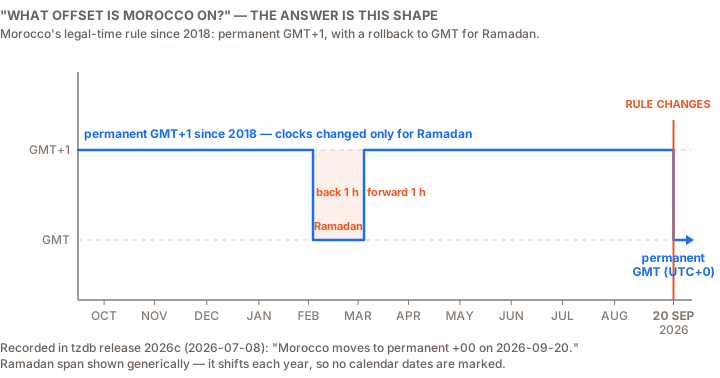
Morocco is the cleanest proof on Earth that an offset and a time zone are different species. Since 2018 the country has kept GMT+1 year-round, with a twist: just before Ramadan, clocks go back an hour to GMT, and return to GMT+1 when the month ends.
So “what offset is Morocco on?” has no single answer. It depends when you ask. The zone is the rule that produces the answer, not the answer itself.
That is what your computer stores. TZif, the standard format for time-zone data, carries offsets from universal time, Daylight saving timeThe practice of moving clocks forward, usually by one hour, in summer to shift daylight into the evening.Read more on Wikipedia ↗ transition rules, and local time designations — the whole rulebook, not a number. The IANA Time Zone DatabaseThe public record of the world's clock and daylight-saving rules, complete since 1970, coordinated by the Internet Assigned Numbers Authority (IANA) and built into phones and computers.Read more on Wikipedia ↗, the one your phone’s operating system ships, describes itself as code and data representing the history of local time. A history: every rule the place has ever used, and the dates it used them.
And the rulebook is under active edit. In June 2026, Morocco’s head of government Aziz AkhannouchMoroccan businessman and politician who became Prime Minister of Morocco in 2021.Read more on Wikipedia ↗ announced that his country’s arrangement is ending: from 20 September 2026, Morocco’s legal time becomes GMT again, permanently.
The quiet editors, and the lawsuit
The database is updated periodically to reflect changes made by political bodies to time zone boundaries, UTC offsets, and daylight-saving rules. Several releases a year; you receive them through your operating-system vendor. The 2026c release alone records Alberta moving to permanent −06 — and Morocco’s move to permanent +00, a change already filed months before any clock moves.
The machinery nearly stopped once. In September 2011, an astrology software company called Astrolabe sued Arthur David Olson and Paul Eggert, the researchers who coordinated the database’s development, claiming copyright over its historical data. The Electronic Frontier Foundation defended them. The case was dismissed, and Astrolabe apologised and agreed to a covenant not to sue.
The suit was odd, but the dependence it threatened is real: software engineers around the world depend on the time zone database to keep timestamps correct everywhere. And the standard itself carries the sued men’s names — RFC 8536, which defines the TZif format, lists Olson and Eggert among its authors.
What an interval doesn’t care about
Time zones are agreements about wall-clock time: whose noon, which midnight, what the meeting invitation means. Elapsed time is none of that.
When you press start on TiCaNo Stopwatch, you are measuring a difference between two moments on one clock. Parliaments can redraw every zone on Earth around you — delete a Friday, bend a date line, hand Morocco back to GMT — and the interval holds. It is the one measurement in timekeeping that needs no agreement at all.
Precision has its own story, of cameras and hundredths and how timing outgrew the human thumb. But precision never needed a parliament either.
A time zone answers to a legislature. An interval answers only to the clock that measured it. That is the whole difference.
Sources
- Time zone — Encyclopædia Britannica, the idealised 15° pole-to-pole definition
- Time Zone Database — IANA, on political bodies changing boundaries, offsets and rules; the 2026c release notes (Alberta −06, Morocco +00); updates reaching users via OS vendors
- RFC 8536: The Time Zone Information Format (TZif) — IETF, February 2019, on what time-zone data consists of; authors Olson, Eggert, Murchison
- Once upon a time zone: how India negotiated its way to one clock — Condé Nast Traveller India, on the 82.5°E meridian, IST from 1 January 1906, the clock vandalism, and the neighbours’ offsets
- Why is there only one time zone in China? — timeanddate.com, on the five zones of 1912–1949, the 1949 consolidation, and Kashgar’s 15:10 solar noon
- Samoa loses a day and jumps forward in time — The Guardian (AP), 30 December 2011
- A history of the International Date Line: recent adjustments — R. H. van Gent, Utrecht University, on Kiribati 1994–95 and Samoa 2011
- Changing the clocks in Spain — El País, 2018, the “gesture of goodwill” reading (contested)
- The ‘hoax’ of the Nazi time zone in Spain — Euronews, March 2026, astronomers disputing the gesture reading
- Venezuela scraps half-hour time difference set by Chávez — Reuters via Voice of America, 15 April 2016
- More than a time change: why Morocco is leaving GMT+1 behind — Morocco World News, July 2026, on the Ramadan arrangement and the 20 September 2026 return to GMT
- Astrolabe v. Olson — Electronic Frontier Foundation (defense counsel in the case), on the 2011 lawsuit and its dismissal