


Set a MetronomeA device for marking musical tempo: it divides time into equal beats and announces them, prescribing a target rather than measuring what was played.Read more on Wikipedia ↗ ticking and play a passage against it. Now stop and ask the awkward question: how fast did you actually play it? The click can’t answer. It told you when each beat fell; it has no opinion about what you did. For that you need the other instrument — the one that measures instead of prescribes. A metronome and a stopwatch are two ways of owning the same TempoThe speed of a piece of music, expressed as a count of beats per minute.Read more on Wikipedia ↗, and confusing them is why so much practice advice talks past itself.
What each one actually does
A metronome is a device for marking musical tempo — it divides time into equal beats and announces them. The number on the scale is a count per minute: M.M. 60, in the old notation, means one beat per second. Metronomes today are commonly software, and they can subdivide a beat as finely as you like. What they cannot do is look back. A click is pure prescription: here is the target, again and again, for as long as you follow it.
A stopwatch is the mirror image. It has no target, no pulse, no opinion about music. It records what happened — and if you tap a lap button at the end of each repetition, it records your passages as a list of durations, comparable pass to pass. One instrument sets the tempo. The other one tells you whether you held it.
The pair matters because the two failures look identical from inside. If you can’t keep a passage at tempo, is the target wrong, or is your execution drifting? You cannot know from the click alone. The measurement is what turns a vague sense of “sloppy” into a number you can act on.
A brief history of the argument
The metronome arrived with a dispute attached to its own invention. The mechanism — a weighted pendulum — was built in Amsterdam around 1812 by Dietrich Nikolaus WinkelDutch inventor (1777–1826) who built the first working metronome in Amsterdam around 1812.Read more on Wikipedia ↗. Johann Nepomuk MaelzelGerman inventor and showman (1772–1838) who patented the metronome in 1815 and mass-produced it.Read more on Wikipedia ↗, after Winkel refused to sell him the rights, patented the device under his own name in 1815, and the credit stuck to him for a century; modern reference works call the ascription erroneous. Maelzel’s marketing did much to make Beats per minute (BPM)A measure of tempo: how many beats fall in one minute.Read more on Wikipedia ↗ the standard tempo language. Even the scale is a convention rather than a law: it originally ran 50 to 160, now runs 40 to 208, and a 1911 encyclopedia called Maelzel’s gradation of it “needlessly and arbitrarily complicated.”
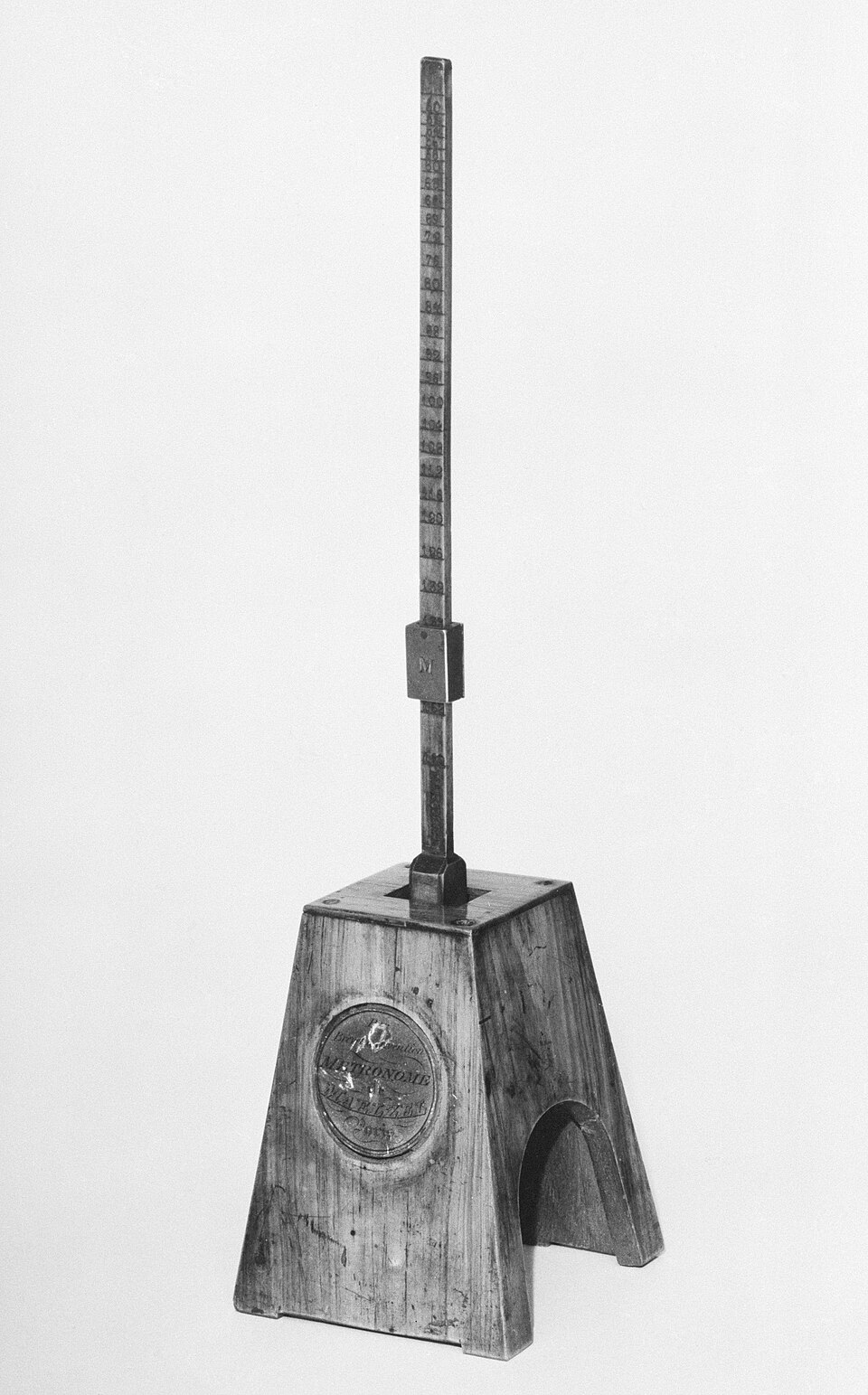
Then the argument moved to the music. Beethoven embraced the device immediately — in 1817 he added metronome marks to his already-published first eight symphonies — and wrote that he had “long purposed giving up those inconsistent terms ‘allegro’, ‘andante’, ‘adagio’, and ‘presto’” in favour of numbers. The numbers have been fought over ever since. Many musicians have considered his marks too fast to play; the pianist and musicologist Peter StadlenAustrian-born pianist, musicologist and critic (1910–1996), an authority on Beethoven performance.Read more on Wikipedia ↗ judged sixty-six of 135 important markings absurdly fast. A 2020 analysis of 36 complete symphony recordings found conductors slowing his marks by six to thirteen beats per minute on average, depending on their school.
And the oldest explanation of all — that his metronome was broken — remains a genuinely open question, in the most literal sense. Beethoven did complain in 1819 that his metronome was broken. One research team modelled a damaged mechanism and found it could yield tempi consistent with the markings, while openly calling the scenario “a bold hypothesis.” Another modelled the same device and ruled the damage out, favouring a misreading of the ambiguous scale. We will never know which: the metronome itself was lost at an exhibition in Vienna in 1921.
The practice room inherited the same argument. Metronome work is among the most widely recommended methods in modern teaching. Until the mid-20th century, playing to a constant click was uncommon and frequently derided as mechanical; Brahms refused metronome marks outright, as reported history has it. A 1911 writer warned that “no student could practise under the tyranny of its beat.” The one controlled study I know of — eight weeks, thirty-nine music majors, several practice strategies including metronome practice — found no significant accuracy differences between the groups. That bounds what “proven” can mean here without proving the opposite. The click has advocates, dissenters, and two hundred years of unresolved feelings. What nobody disputes is that knowing what you played is useful.
The measurement half of practice
Which is where the stopwatch earns its place in a music room. The workflow that works: put your metronome of choice — any of the hundred apps — on the tempo you’re aiming at, and run a stopwatch beside it. Play the passage. Tap lap at the end of each repetition. What you get is a column of passage times: this run, the next run, the one after. Comparable by construction, because every lap is captured the same way, while the stopwatch runs.
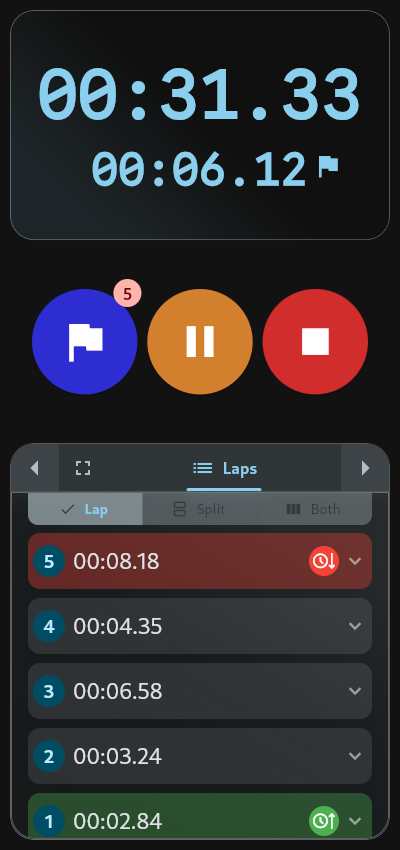
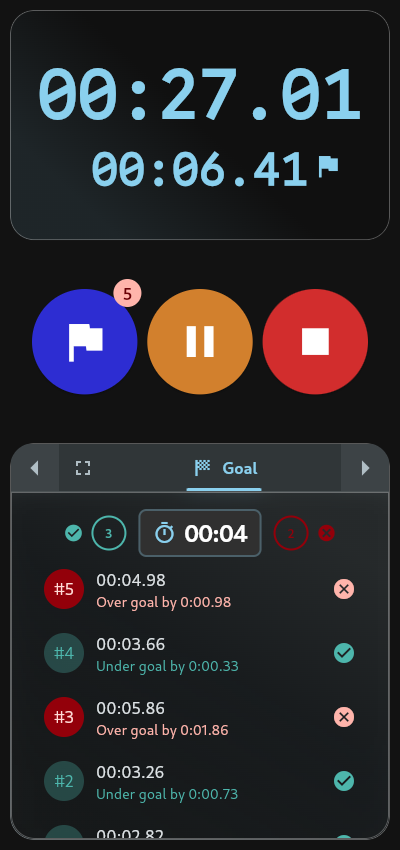
A few things make this workable with your hands on an instrument. The lap press gives configurable audio and haptic feedback, so you feel the tap land without looking at a screen. If you turn on Keep Screen On in settings, the display stays awake while the stopwatch runs — it is off by default; it’s your battery. Each lap can carry a custom title, so “bridge, take 3” stays labeled. The Laps tab flags your fastest and slowest repetition of the session, the Pro-only Stats tab adds the average and a trend, and a stopped take saves as a named session with its average lap time for comparing today against last week. There is even a Goal tab that judges every tapped lap a hit or a miss against a target time — a repeatability scoreboard for exactly this kind of work. The lap-versus-split arithmetic — each passage’s own time, plus the running total — is its own old argument.
One honesty note, because overselling precision is its own failure: tapping is a human skill. The study of keeping time against a pulse — sensorimotor synchronization — has a consistent finding that taps tend to land slightly ahead of the beat, with measurable variability, as Bruno Repp’s review of the tapping literature documents. Lap times in hundredths of a second do not grade your internal clock to the millisecond. What they do is make passes comparable, which is the whole point. If you want what the decimals do and don’t mean, that’s its own subject; so is what happens to a running timer when the screen goes dark.
Two instruments, one tempo
The metronome’s job is before you play: it sets the target, and the argument about targets is old, respectable, and unresolved. The stopwatch’s job is after: it reports what you did, without judgment, to a precision that makes repetitions comparable. Neither substitutes for the other — a click without measurement is doctrine, and a clock without a target is just data.
That is the honest division of labor. Your metronome sets the target; TiCaNo is the measurement half. The click tells you when to play. The stopwatch tells you what you did.
Sources
- Britannica (modern and 1911 editions), the Museum of Music History, and Guarneri Hall’s cited history — the Winkel/Maelzel record, the scale’s history, and the “tyranny of the beat” dissent.
- Martin-Castro & Ucar, Public Library of Science (PLOS) ONE (2020), and Forsén, Gray, Lindgren & Gray, Notices of the American Mathematical Society (2013) — the Beethoven marks dispute, the conductor slow-down figures, and both sides of the broken-metronome hypothesis.
- Beethoven’s 1817 letter to Hofrath von Mosel, as quoted in the American Mathematical Society Notices paper.
- Bruno H. Repp, “Sensorimotor synchronization: A review of the tapping literature”, Psychonomic Bulletin & Review (2005).
- Melody A. Hanberry, Louisiana State University (LSU) doctoral dissertation (2004) — the null-result practice-strategy study, N=39.
- Dave Wilken, wilktone.com — the teacher-majority view, as practitioner opinion.
- TiCaNo Stopwatch v1.6.2, the shipped build this post’s product claims are pinned to — the lap engine and its arithmetic, lap titles, feedback on the lap press, the Keep Screen On default, the Laps/Goal/Stats surfaces, and the absence of any metronome feature (there is none, in any of the three apps — this post is about the measurement half, not a missing click).