


Tonight, at some exact minute, a bright star will cross the Meridian (astronomy)The imaginary north–south line across the sky through the point directly overhead. The Sun at noon, or a star, crossing it is at its highest.Read more on Wikipedia ↗ — the invisible north–south line drawn overhead. Note the time. Tomorrow the same star crosses it about three minutes and fifty-six seconds earlier, and the night after, earlier again. Nothing is drifting. Your clock is fine. The sky simply keeps a different day than you do, and it is about four minutes shorter.
The question arrives constantly. On the astronomy corner of Stack Exchange, “why is the solar day longer than the sidereal day?” has drawn 1,261 views, and a time-zone variant — why 360°/24 and not 361°/24? — has drawn 5,946. People keep independently discovering that the sky runs on 23 hours 56 minutes, and asking why their 24-hour world disagrees. The answer is short, and it is not an error in either clock.
Two clocks, one planet
The day your clock keeps is solar: one return of the Sun to the meridian. The day the sky keeps is sidereal — literally star-time, from the Latin sidus, a star or constellation — and it is defined as one return of the EquinoxEither of the two yearly moments when the Sun crosses Earth's equatorial plane, making day and night nearly equal in length worldwide.Read more on Wikipedia ↗. The US Naval Observatory (USNO), which publishes Sidereal timeTime kept by Earth's rotation measured against the distant stars rather than the Sun. A sidereal day is about 23 hours 56 minutes; local sidereal time tells which part of the sky is crossing the meridian.Read more on Wikipedia ↗ as a data service, defines it as the hour angle of the equinox: how far the sky has turned since the equinox last crossed your meridian. That interval — two successive crossings of the equinox past a given meridian — lasts about 23 h 56 m 04 s of civil time. In sidereal time itself, it is exactly 24 h 00 m 00 s. The sidereal clock’s day is, by its own measure, a perfectly ordinary day.
Both clocks are built on the same spinning Earth. They differ only in what they point at: the Sun for one, the equinox — effectively the fixed stars — for the other. A given star crosses the meridian at the same sidereal time every day, but about 3 m 56 s earlier in solar time each day. Four minutes, give or take, is the rounded version.
The reason is the orbit
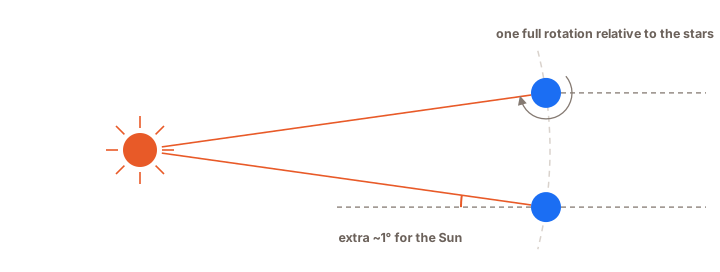
Earth does not spin in place. While it turns once, it also travels about 1/365 of the way around its orbit. So after one full rotation relative to the stars, the Sun is no longer where it was — the planet has moved, and Earth must rotate about 1° further to bring the Sun back to the meridian. That extra degree is roughly 1/365 of a full turn, and 1/365 of a day is about four minutes. The Solar dayThe interval between two successive passages of the Sun across the same meridian. Its apparent length varies, while the mean solar day is 24 hours.Read more on Wikipedia ↗ is about four minutes longer than the sidereal day. One rotation and one day are simply different things.

The 24 hours on your wrist, meanwhile, is not a measurement of the Sun at all — it is an agreement. The mean solar day contains exactly 24 hours by definition, and everyday timekeeping runs on it. The apparent solar day, what a sundial actually measures, wanders a little through the year; that story is the sundial post’s to tell.
Where the four minutes go
Follow the gap for a year and it adds up to something satisfying. A sidereal clock gains about 3 m 57 s on the wall clock every day — after one civil day it reads 24 h 03 m 57 s ahead. Keep going and the gain accumulates into exactly one full lap. In a year there are about 366¼ sidereal days against 365¼ solar days. Charles A. Young’s 1898 college textbook states it in words a modern course could reuse: the difference is “just one day in a year”. The four minutes a day are the extra rotation, paid out in daily instalments.
It is tempting — almost irresistible — to connect those instalments to the leap year. Resist. They are two different extras wearing the same coat. The sidereal year’s extra day is one extra rotation: 365¼ turns’ worth of four-minute gaps, because the Earth goes around the Sun once and its orbit adds one full turn to the year’s tally.
The calendar’s leap day exists because the tropical year — the seasonal year — is 365.242 solar days, a quarter-day of orbital time that the calendar rolls up every four years. The numbers land within a fraction of a percent of each other, and the mechanisms share nothing. One is rotation, the other orbit. The four minutes do not pay for February 29.
Neither clock is the true one
If the stars’ clock sounds like the honest one and the Sun’s like the compromise, drop that thought at the door. Earth’s rotation — the engine of both — is not constant: it speeds up and slows down, with a long-term slowdown underneath, which is one of the two reasons leap seconds exist. The US National Institute of Standards and Technology (NIST) puts it flatly: Coordinated Universal Time (UTC) is kept by atomic clocks more stable than the Earth’s rotational rate. Sidereal time is not more accurate, not truer, not closer to reality. It is the same wobbly rotation, pointed at a different reference.
The last decimal
Even “one rotation relative to the stars” is a rounding. The equinox itself drifts slowly against the stars — PrecessionA slow change in a rotating body's axis. Gravity from the Sun and Moon makes Earth's axis trace a circle over roughly 26,000 years.Read more on Wikipedia ↗ — so the equinox-referenced mean sidereal day is about 0.008 s shorter than Earth’s actual rotation period. And since 2000, the institutional definition has run deeper than the stars. The International Astronomical Union (IAU) redefined the underlying angle so that UT1 is linearly proportional to the Earth Rotation Angle, whose rate corresponds to a rotation period of 86,164.0989 seconds — 23 h 56 m 4.0989 s. “One turn against the stars, roughly” is the supportable sentence. Exactly never is.
Elsewhere in the solar system the contrast stops being subtle. Venus rotates once in about 243 Earth days — retrograde — which is longer than its 224.7-day orbit. But that is the sidereal rotation; the day-night cycle a Venusian sundial would measure is only about 117 Earth days, shorter than the Venusian year. Rotation, orbit, and day are three different things, and the one you mean depends on the clock you keep.
The clock you actually need
Astronomers keep the second clock for a practical reason: in sidereal time, a star rises and transits at the same time every day. The sidereal time right now equals the right ascension on the meridian — which makes the sky’s schedule readable off a clock face. If time units and their history are your interest, the moment has a post of its own. A stopwatch, meanwhile, occupies the third position and needs neither reference: a duration is the same number of ticks wherever the planet happens to be pointing. The laps in TiCaNo never ask the Sun or the equinox — they only count.
Sources
- US Naval Observatory (USNO), Sidereal Time data service — the equinox hour-angle definition; 23 h 56 m 04 s vs exactly 24 h sidereal; the 3 m 56 s daily transit drift; the 0.008 s equinox-drift gap; the 24 h 03 m 57 s daily gain.
- USNO, Computing Approximate Sidereal Time (FAQ) — sidereal time as rotation with respect to the fixed stars.
- USNO Circular 179, reproducing IAU 2000 Resolution B1.8 — UT1 linearly proportional to the Earth Rotation Angle; the 86,164.0989 s rotation period.
- OpenStax Astronomy 2e §4.3, Keeping Time — the 1/365 extra rotation taking about four minutes; the mean solar day’s exactly-24-hour definition; the apparent day’s variation; astronomers’ preference for sidereal time.
- Las Cumbres Observatory, Solar Time vs. Sidereal Time — the 23 h 56 m 4.1 s figure; sidereal time as the right ascension on the meridian.
- NASA (the US National Aeronautics and Space Administration) planetary fact sheets (Venus and Earth) — Venus’s −5832.6-hour retrograde rotation, 224.701-day orbit, 116.75-day day-night cycle; Earth’s 365.256-day sidereal and 365.242-day tropical years.
- US National Institute of Standards and Technology (NIST), Leap Seconds FAQs — Earth’s irregular, slowing rotation; atomic clocks more stable than rotation.
- Etymonline, sidereal — Latin sidus/sideris, “star, group of stars, constellation”.
- Charles A. Young, A Text-book of General Astronomy (1898), §26 — 366¼ sidereal days against 365¼ solar; “just one day in a year”.
- Stack Exchange question view counts (astronomy site, fetched 2026-09-29) — the two questions quoted in the opening.