


In July 2014, a man planning a SundialA device that tells the time from the shadow a fixed pointer casts on a marked face as the Sun moves across the sky.Read more on Wikipedia ↗ in Ghana asked an astronomy forum a practical question: he would be there about three weeks — did he need to adjust the numbers during his stay? It sounds like a question about craftsmanship. It is actually a question about two different kinds of time, and once you see the split, the sundial in your garden stops being a broken clock and starts being the honest one.
Two kinds of time
A correctly built, correctly placed sundial reads Solar timeTime told by the Sun, as on a sundial. Apparent solar days vary through the year because of Earth's elliptical orbit and tilted axis; mean solar time evens them out.Read more on Wikipedia ↗: the Hour angleThe angle between the meridian and a body in the sky, measured in hours — the Sun's hour angle is zero at solar noon.Read more on Wikipedia ↗ of the actual Sun in the actual sky. The U.S. Naval Observatory, whose business this is, calls it “a kind of raw measurement of where the Sun actually is in the sky.” Noon is the moment the Sun crosses your Meridian (astronomy)The imaginary north–south line across the sky through the point directly overhead. The Sun at noon, or a star, crossing it is at its highest.Read more on Wikipedia ↗. Nothing is averaged.
Your watch reads something else. To make clocks possible, astronomers imagined a fictitious point — the mean sun — moving at a constant rate along the celestial equator, averaging out the real Sun’s uneven motion over the year. Your watch ticks through the modern descendant of that average, and the tick itself is cesium: a day’s worth of SI (International System of Units) seconds, which is not a fixed interval of Earth’s rotation at all.
The difference between the two, at the same meridian, is the Equation of timeThe difference between apparent solar time (a sundial) and mean solar time (a clock) at the same place; it reaches about 16 minutes during the year.Read more on Wikipedia ↗: apparent minus mean, in the convention used here. It is the reason a well-made sundial and a well-set clock disagree even at the same longitude. Around early November the sundial runs about 16 minutes ahead of the mean clock; near mid-February, about 14 minutes behind. Those are the extremes, and they are worth a sign convention warning: some almanac tables state the same quantities with the opposite sign, so check which way a source counts before quoting it.
Why the Sun is crooked
Two effects cause the wobble, and neither one is the main cause — the Naval Observatory says this explicitly, because the “it’s the elliptical orbit” answer is the popular half-truth. Axial tilt alone would swing the equation of time by about ten minutes either way. Orbital eccentricity alone, about seven and a half. The real curve is the two superimposed.
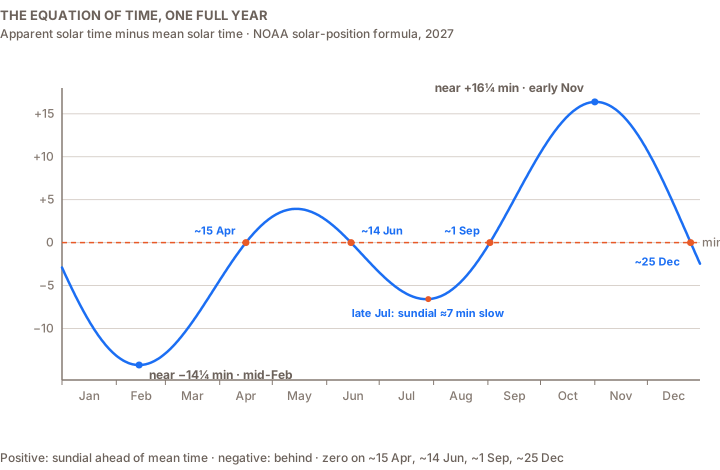
The eccentricity part is Kepler’s doing. Earth moves fastest at perihelion, in early January, and slowest at aphelion, in early July — the angular rate differs by almost 7 percent across the year. The tilt part comes from the Sun tracking the ecliptic rather than the equator while the dial counts turns of the Earth. Two comparable rhythms, added together.
The disagreement also creeps day by day, which was the Ghana question. The sundial’s offset from the clock changes by at most about half a minute a day, with the apparent solar day at its longest — some 28 seconds over 24 hours — in late December. Over the asker’s three July weeks, his dial would drift by roughly three minutes. Yes, he needed to adjust the numbers. No, his sundial was not broken.
The watch’s share of the gap
Here is the part most explanations skip: even with the equation of time at zero, the sundial and the watch still disagree, because your zone’s clocks keep the mean time of one defining meridian, not of your street. Mean solar time differs from civil time by four minutes per degree of longitude away from that meridian. Omaha, Nebraska, at 96 degrees west, sits a permanent 24 minutes away from the central-zone meridian’s mean time. Bristol, ten minutes of time west of Greenwich, sees the Sun cross its meridian ten minutes later than Greenwich’s.
So the full gap between a dial and a watch is three separate terms: a constant longitude offset, the seasonal equation of time, and — where your country uses it — a whole-hour daylight-saving shift laid on top. Daylight saving moves the watch, never the dial, and it is its own story. Any explanation that merges the three into one “the sundial is off” number has already gone wrong.
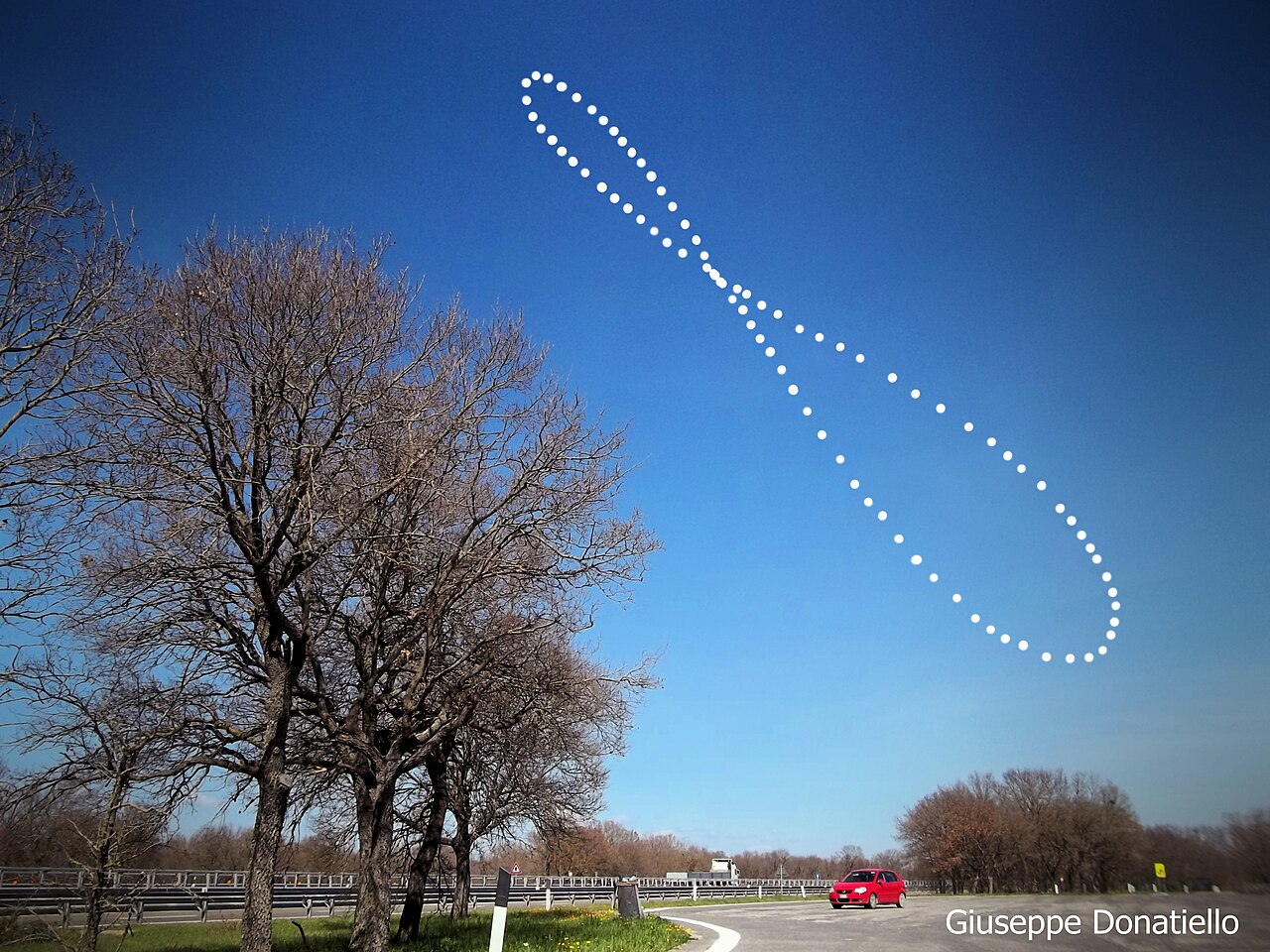
Only a sundial sitting exactly on its zone’s defining meridian, in a country not then on summer time, matches the watch — and only on the four days a year when the equation of time crosses zero. Those fall near 15 April, 13 June, 1 September and 25 December. Not the solstices, not the equinoxes — a coincidence people assume and the dates refuse. Photograph the Sun at mean-time noon through a year and you get the figure-8 of the analemma: the equation of time laid sideways against the Sun’s seasonal height. The same wobble, without any dial at all, splits your earliest sunset from your latest sunrise around the December solstice.
Which one is right
The defensible version of the provocation: the sundial reports where the Sun actually is. The watch reports a smoothed average plus a zone meridian. On the day the two disagree by 16 minutes, the sundial is not in error — it is measuring a different thing, and measuring it honestly.
The inversion matters just as much: mean time is not an error either. It is the engineering compromise that made uniform clocks possible — and it never fully left: the standard American navigation manual still teaches the equation of time today. The dial measures; the clock agrees on average. Different jobs.
One practical warning, because it is the most-viewed sundial question of the four: the GnomonThe pointer of a sundial — the part whose shadow marks the time. To read true time it must point at the celestial pole, parallel to Earth's axis.Read more on Wikipedia ↗ must point at the celestial pole, parallel to Earth’s rotation axis — the shadow then sweeps uniformly, 15 degrees an hour, because the Earth turns that steadily. A compass will not do; magnetic north is not true north, and where declination runs large it dwarfs the equation of time. And the dial reads hour angle, not the Sun’s compass bearing — the Sun is not at the same azimuth at the same hour, not even at noon.

The clock that outlasted the calendar
History runs the other way from the intuition. Sundials are at least 3,500 years old — the earliest known survives from Egypt — and the first ones divided daylight into twelve temporary hours that ran long in summer and short in winter. Mechanical clocks were the junior partner for most of that story; the French railways were still regulating their clocks by sundials at the end of the nineteenth century. The clock did not win by being more truthful.
The equation of time is not eternal plumbing, either. With a different axial tilt or orbital eccentricity — past or future — the curve would look quite different. The Long Now Foundation, building a clock meant to run 10,000 years, cast a bronze cam encoding how the equation of time evolves across exactly that span; one sits in the Royal Museums Greenwich collection. A correction machined to outlast the calendar it corrects.
And a duration needs none of it. Elapsed time is indifferent to meridians, zones, seasons and cesium — the moment you press start is zero, and every lap counts from there. That is the bargain TiCaNo makes on every run: no mean sun, no defining meridian, just the interval. The Sun, meanwhile, keeps its own kind of time whether we average it or not — the leap second is what happened when the two kinds could no longer be ignored.
Sources
- U.S. Naval Observatory, “The Equation of Time” — apparent vs mean solar time, the two comparable causes, the sign convention, the worked examples, the analemma and the December sunset/sunrise split.
- Bowditch, The American Practical Navigator (2019 ed.), Ch. 16 — the dated extrema (−14 m 13 s mid-February, +16 m 26 s early November) and the definitions.
- Royal Museums Greenwich, “Sundials” — the 3,500-year history, temporary hours, the Bristol example, the French railways; and the collection record for the Long Now equation-of-time cam.
- US National Institute of Standards and Technology (NIST), “Solar Time” (A–Z) and “What Determines the Length of the Day?” — the definitions and the cesium-day figure.
- National Oceanic and Atmospheric Administration (NOAA) Global Monitoring Laboratory, solar position calculations — the formula the derived dates and daily rates were computed from.
- astronomy.stackexchange.com questions 58112, 1120, 1362 and 13776 (with their answers) — the four questions and their askers, including the Ghana sundial; view counts via the Stack Exchange application programming interface (API), September 2026.