



Somebody asked Electrical Engineering Stack Exchange a fair question: how do you get “decent” clock accuracy out of a microcontroller — and they defined decent. Max one second of Clock driftThe gradual divergence of a clock from true time, because its rate is never perfectly exact.Read more on Wikipedia ↗ in a year. They had read about Oven-controlled crystal oscillatorA crystal oscillator kept at a constant temperature inside a tiny oven, so its frequency barely changes.Read more on Wikipedia ↗ and found it hard to believe such ovens hide inside wristwatches. The thread has 7,916 views.
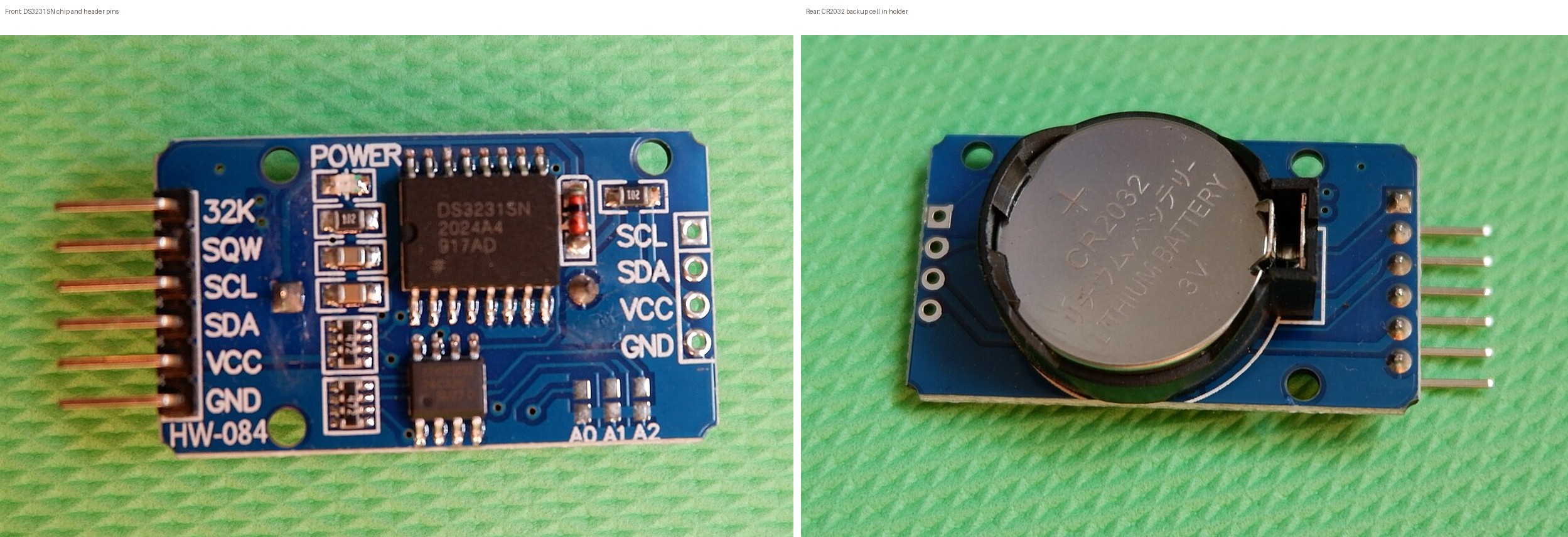
The short answer: they don’t. The wristwatch’s accuracy doesn’t come from a better crystal — it comes from correcting a cheap one. A real part you can buy today for about two dollars at volume does exactly that: the DS3231, a Real-time clock (RTC)A dedicated chip that keeps the date and time-of-day while a device sleeps or is off, usually on its own coin-cell battery.Read more on Wikipedia ↗ with the crystal built in and corrected, continuously, by its own silicon.


The long answer is a ladder. Four rungs, from the stopwatch world you already know to the one-second-a-year goal, and what each rung costs.
Rung zero: why quartz
Start with the material, because there is only one candidate. In John R. Vig’s reference tutorial on crystal oscillators for the Institute of Electrical and Electronics Engineers (IEEE) frequency-control community, quartz is the only material known that combines PiezoelectricityThe property of some crystals — quartz among them — of vibrating electrically when a voltage is applied, and vice versa; the reason a quartz blank can keep time.Read more on Wikipedia ↗, zero-temperature-coefficient crystal cuts, a stress-compensated cut, low energy loss, manufacturability, and natural abundance. Of man-grown crystals, only silicon is produced in greater quantity — about three thousand tons a year as of 1997.
The “cut” is where accuracy begins. A quartz blank cut from the crystal resonates at a set frequency, and the angle of that cut determines how the frequency answers temperature. The 32,768 Hz tuning fork that runs watches and cheap clocks turns over — passes through its flattest point — at wrist temperature, typically somewhere between 25 °C and 28 °C, with 27 °C a common figure.


Why two stopwatches started together drift apart left the reader at exactly this point: away from turnover, a tuning fork’s error grows as the square of the distance from it. The Epson FC-135’s parabolic coefficient is −0.04 ppm per °C², which at fifteen degrees off turnover already means up to 9 ppm — nearly five minutes a year from temperature alone. A bare crystal is a fair-weather friend.
Rung one: the bare crystal, ±20 ppm
The tuning-fork crystal your microcontroller uses is specified at ±20 ppm at 25 °C. That number is a manufacturing tolerance band — some units sit near zero, some near the edge — not a promise that every crystal is twenty off. In time, it is about ten minutes a year if nothing corrects it. That is rung one: where the StackExchange asker’s microcontroller lives, and where the two drifting stopwatches live.
Rung one is cheap, but it is honest about its limits. Moving up means answering a question: which error do you attack first?
Rung two: the chip that measures and corrects
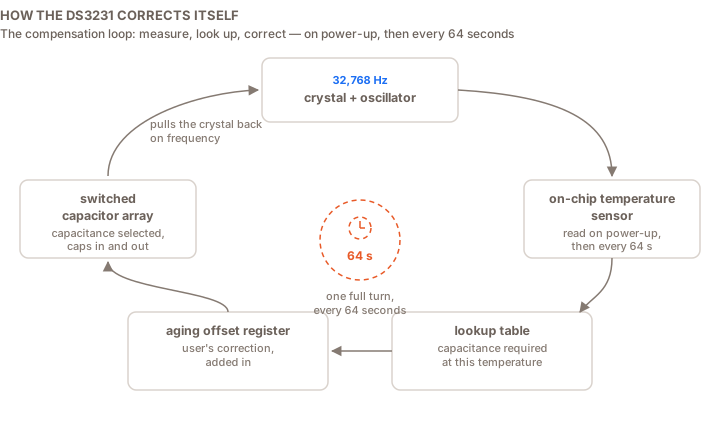
The DS3231 attacks temperature. It is a low-cost I2C (inter-integrated circuit) real-time clock (RTC) with the crystal, the oscillator, a temperature sensor and correction logic in one package. And here is the mechanism the datasheet never dramatises. Every 64 seconds, the chip reads its on-chip temperature sensor, looks up the capacitance the crystal needs at that temperature, adds any user aging correction, and switches capacitors in and out of an internal array — pulling the oscillator back onto frequency. No oven: the part hustles instead of heating. Measure, look up, correct, every sixty-four seconds, forever.
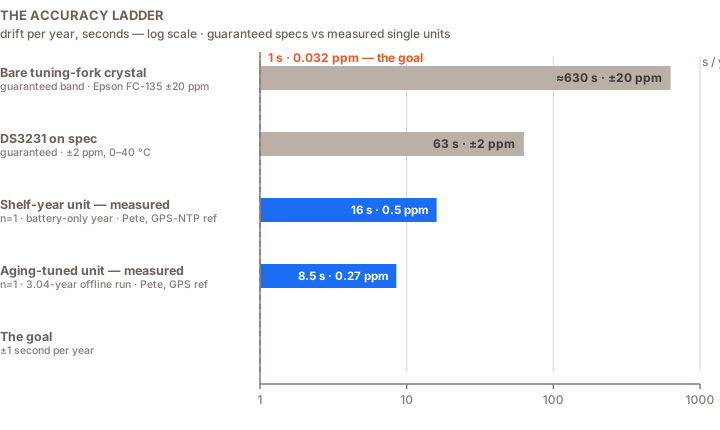
The spec that buys: ±2 ppm from 0 to 40 °C, ±3.5 ppm down to −40 and up to +85. In the honest arithmetic, ±2 ppm is ±63 seconds a year — about a minute. The vendor’s own time-domain sentence agrees: the Temperature-compensated crystal oscillator (TCXO)A crystal oscillator whose circuit measures temperature and corrects the frequency error it causes, without needing an oven.Read more on Wikipedia ↗ (TCXO) “maintains the RTC to within ±2 minutes per year” across the full temperature range. A second a year is 0.032 ppm territory — call it sixty times tighter than the spec.
The trap hiding in that spec sheet is dimensionless units. Two parts per million of a year is not two seconds a year; multiply 2×10⁻⁶ by 31,557,600 seconds and you get 63 seconds. Anyone who reads “2 ppm” as “2 seconds a year” has just improved the chip thirty-fold by accident.
Real chips do better than the spec, and there are measurements. Pete at heypete.com set a battery-only DS3231 from a GPS-synced clock and left it on a shelf for a bit over a year: 16 seconds of drift, about 0.5 ppm. In a separate experiment he synchronized ten of the chips at once and tracked them five months against a GPS-referenced clock. All within their advertised tolerances, his five measured chips clustering around 0.5 ppm. A four-chip bench comparison of real-time clocks in 2016 measured the uncompensated DS1307 at about 15 ppm — roughly a second a day — while the temperature-compensated DS3231 sat below the rig’s 0.3-ppm resolution floor over 3.4 million seconds. That is the rung-one-to-rung-two gap, measured.
About the “two dollars”: it holds at volume pricing (the crystal DS3231SN# lists at $4.11 for one, $2.55 each at a thousand) and on the clone-module market; single-unit Western retail for the microelectromechanical-systems (MEMS) variant runs to $11.96 at DigiKey. And that module market deserves its own caution, below.
Rung three: calibrating the residual
Temperature compensated, what remains is initial tolerance and aging — “the systematic change in frequency with time due to internal changes in the oscillator,” in the words of the US National Institute of Standards and Technology (NIST). The DS3231’s own aging spec is ±1 ppm in the first year after the chip is soldered, up to ±5 ppm over ten years. And aging never stops: calibrate once and the crystal keeps drifting on beneath your correction.
Two very different devices answer this rung, one old and one new.
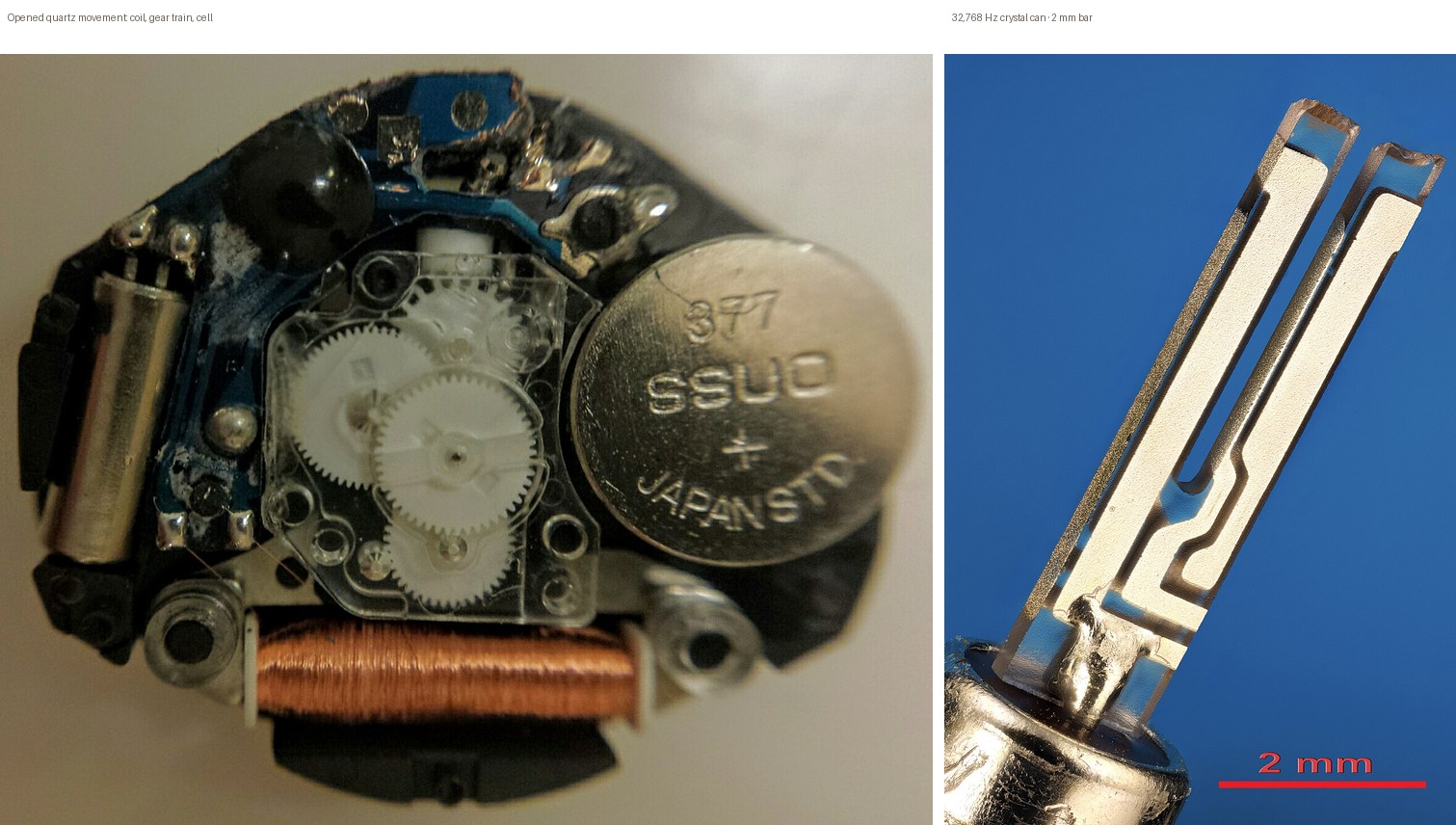
The wristwatch does it in the divider. NIST, characterizing four low-cost quartz watches, found three of their four raw oscillators off by 59 to 100 ppm — the offsets “perhaps intentionally introduced” — yet the watches ran to much better than a second a day. The mechanism is inhibition compensation. Design the circuit so the crystal runs deliberately fast, then suppress a programmable number of oscillator pulses before the frequency divider that drives the hands. The chip counts what it must throw away. Pulses can be added or suppressed to compensate for aging or temperature too. This is the answer to the StackExchange asker’s watch question: not an oven, arithmetic — and a cheap watch can spec ±15 seconds a month this way.
The DS3231 does it in a register. The aging offset register trims frequency in steps of about 0.1 ppm, and the datasheet is explicit that using it is optional — the spec holds with it at zero. But the Cave Pearl Project, working against a Global Positioning System (GPS) one-pulse-per-second reference, measured a chip drifting at about 1 ppm with the register at default. They wrote −21 into it, and the drift went to near zero. The author’s extrapolation for a chip dialed in this way is less than a second a year — near the calibration temperature. That is the honest caveat: an offset tuned at one temperature shifts the whole frequency-temperature curve, so a chip calibrated on the bench is calibrated for the bench.
And there is a record worth quoting. Pete, the same experimenter, tuned one DS3231N via that register against a GPS-disciplined reference, then left it completely offline on a coin cell — through an international move — for 3.04 years. It gained 26 seconds. That is 0.27 ppm long-term, about 8.5 seconds a year, and it is the best documented long-run figure for a chip in this class. Still not a second a year. Still eight and a half times short of it.
The lottery ticket
One more thing the reader should know before clicking buy. The “DS3231 module” of the marketplace is not one product. The crystal-based DS3231 and the MEMS-based DS3231M — a different resonator technology with a looser 5 ppm spec — ship mixed at random on clone boards. The chips on those boards are often not new: date codes back to 2006, wear visible, likely pulled from old equipment. In 2020 the vendor’s product-status list showed the leaded crystal variants discontinued while the RoHS version continued; the module stock sold since has been a mix. Buying “a DS3231 module” does not establish which spec you got. (Its 2026 availability: not verified either way, and not claimed.)
The top of the ladder
A second a year is 0.032 ppm. The chip’s spec is sixty times looser; the best single calibrated unit documented runs eight to nine times looser. The honest paths to the top rung are per-unit calibration at a controlled temperature — the Cave Pearl extrapolation — or a different technology: the oven-controlled oscillators of the stopwatch-drift story, or the AT-cut crystal the watchmaker Citizen says powers its one-second-a-year Calibre 0100. Both exist; neither is two dollars.
The satisfying truth is that the cheap chip doesn’t beat physics — it hustles it. It carries a correction table for its own crystal, reads its own temperature every sixty-four seconds, and re-tunes itself for pocket change. The one-second-a-year goal survives only as the famous question’s target: what the asker wanted, not what the two-dollar chip promises. For measuring what a rung-one world actually delivers, a stopwatch remains the honest instrument — and if this ladder interests you, Why two stopwatches started together drift apart tells the drift side of the story.
Sources
- DS3231 datasheet, Maxim Integrated / Analog Devices (archived) — ±2 ppm / ±3.5 ppm specs, TCXO mechanism, 64-second refresh, ±3 °C sensor, aging spec, aging-offset register, “±2 minutes per year”.
- Epson FC-135 32.768 kHz tuning-fork crystal datasheet — ±20 ppm tolerance at +25 ±5 °C, turnover +25 ±5 °C, parabolic coefficient −0.04 ppm/°C².
- Michael A. Lombardi, “The Accuracy and Stability of Quartz Watches,” NIST — raw 59–100 ppm offsets, inhibition compensation, the one-second-per-day result, aging definition.
- John R. Vig, “Quartz Crystal Resonators and Oscillators… a Tutorial” (IEEE Ultrasonics, Ferroelectrics and Frequency Control Society) — why quartz, the AT-cut milestones (1934) and first TCXO (1956), tonnage.
- [time-nuts] DS3231 drift over a year (febo.com, July 2017) — the 16-second shelf year.
- Pete, heypete.com — five-month ten-chip fleet (~0.5 ppm), the module-market mix and 2006 date codes, the 2020 end-of-life (EOL) note, and the 3.04-year offline tuned unit (26 s, 0.27 ppm).
- Ed Mallon, Cave Pearl Project — aging-offset calibration against GPS 1PPS; the −21 result; the sub-second-per-year extrapolation at calibration temperature.
- SwitchDoc Labs, four-RTC bench comparison (2016) — DS1307 at ~15 ppm measured, DS3231 below the 0.3-ppm floor.
- Electrical Engineering Stack Exchange #655312 (archived) — the question and the oven disbelief; view count per the 2026-09-06 scout pass.
- Electronics distributor LCSC (lcsc.com) and DigiKey listings (2026-09-07) — $4.11/$2.55 volume for DS3231SN#, $11.96 single-unit DS3231M+.
- Citizen, Calibre 0100 page — the ±1 s/yr claim and AT-cut, attributed to the manufacturer.